
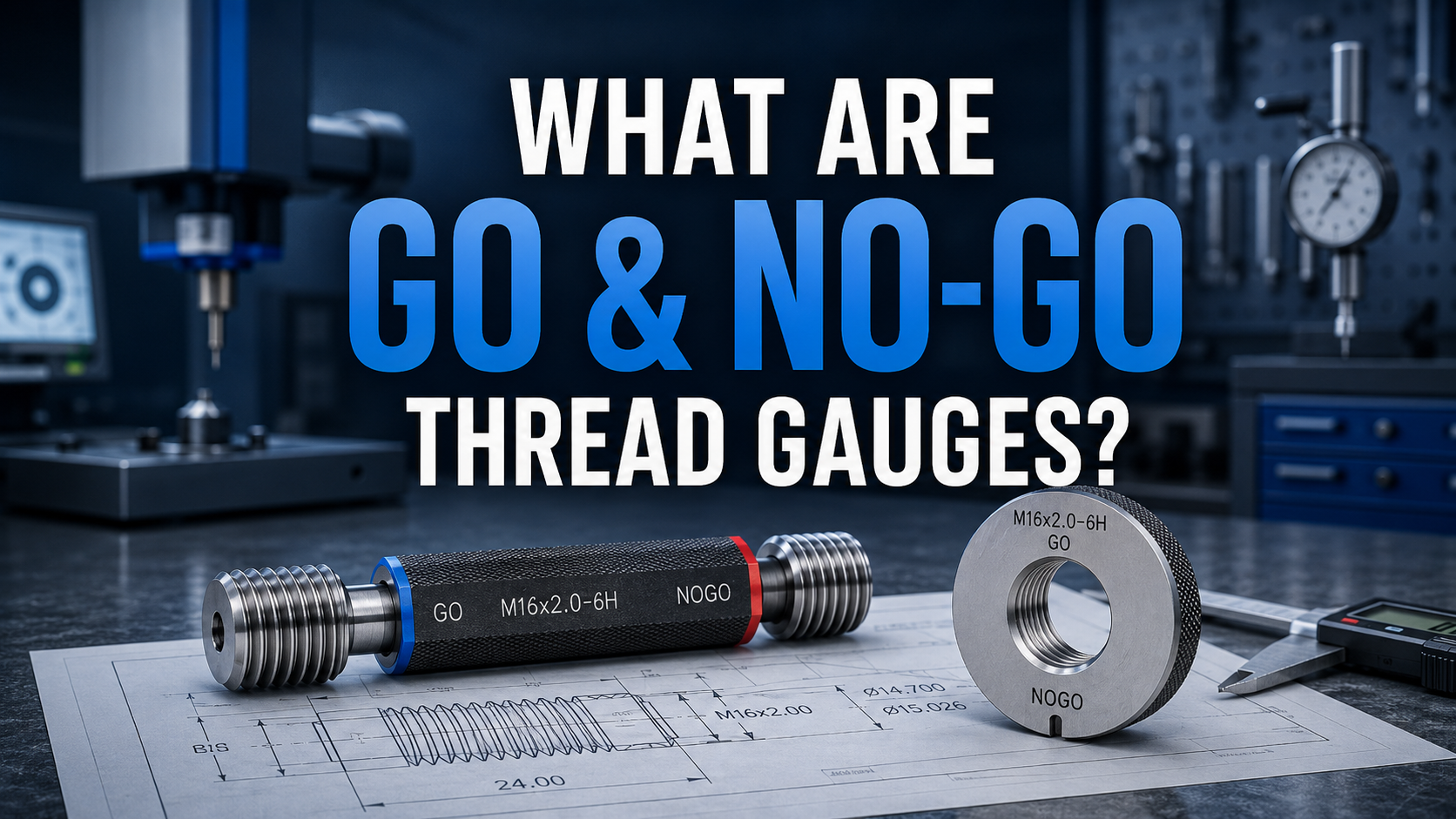
GO and NO-GO thread gauges are inspection tools used to quickly check whether threaded parts are within tolerance. They are commonly used by machine shops, manufacturers, oilfield companies, and quality control teams to verify internal and external threads.
A GO gauge confirms that the thread meets the minimum acceptable condition and should fit properly. A NO-GO gauge checks the opposite limit and should not fully fit if the part is acceptable.
Together, GO and NO-GO thread gauges help inspectors make fast pass/fail decisions during production and final inspection.
How Does a GO Thread Gauge Work?
The GO side of a thread gauge is designed to fit the part when the thread is acceptable.
For an internal thread, such as a tapped hole, the GO end of a thread plug gauge should thread in smoothly. For an external thread, such as a bolt or stud, the GO thread ring gauge should thread onto the part properly.
If the GO gauge will not fit, the thread may be undersized, damaged, dirty, incomplete, or out of tolerance.
How Does a NO-GO Thread Gauge Work?
The NO-GO side is used to confirm that the thread has not exceeded the allowed tolerance limit.
In most inspections, the NO-GO gauge should not fully engage the part. If the NO-GO gauge threads in too far or fits completely, the part may be oversized, worn, or outside the acceptable thread limits.
This makes the NO-GO gauge an important tool for catching parts that may appear usable but do not meet the required specification.
GO vs. NO-GO Thread Gauge Comparison
| Gauge Type | Purpose | Expected Result |
|---|---|---|
| GO thread gauge | Checks that the thread meets the required fit | Should fit properly |
| NO-GO thread gauge | Checks that the thread has not exceeded the tolerance limit | Should not fully fit |
| Thread plug gauge | Checks internal threads | Used on tapped holes, nuts, couplings, and bores |
| Thread ring gauge | Checks external threads | Used on bolts, studs, shafts, and threaded rods |
A simple way to remember it is:
The GO gauge should go. The NO-GO gauge should not go.
Why GO and NO-GO Gauges Need Calibration
GO and NO-GO gauges are used to decide whether parts pass or fail inspection. If a gauge is worn, damaged, corroded, or out of tolerance, it may accept bad parts or reject good parts.
Regular thread gauge calibration helps confirm that your GO and NO-GO gauges are still accurate and reliable. This is especially important for companies working with tight tolerances, oilfield parts, API-style threads, or customer-controlled inspection requirements.
How Often Should GO and NO-GO Thread Gauges Be Calibrated?
Many companies calibrate GO and NO-GO thread gauges every 12 months. However, gauges used heavily or for critical applications may need calibration every 3 to 6 months.
A shorter calibration interval may be needed when gauges are used for:
- Daily production inspection
- High-volume manufacturing
- Oilfield or industrial components
- API-threaded parts
- Tight-tolerance work
- Customer-audited jobs
- Harsh shop environments
If a gauge is dropped, damaged, rusty, or giving inconsistent results, it should be removed from service and checked before being used again.
Need GO and NO-GO Thread Gauge Calibration in Houston?
Houston Precision provides thread gauge calibration in Houston for GO and NO-GO thread gauges, thread plug gauges, thread ring gauges, API gauges, setting plugs, and other precision inspection tools.
Whether your gauges are used for daily production or critical oilfield inspection, Houston Precision can help keep your equipment accurate, documented, and audit-ready.
Contact Houston Precision today to schedule GO and NO-GO thread gauge calibration in Houston.
FAQs About GO and NO-GO Thread Gauges
What are GO and NO-GO thread gauges?
GO and NO-GO thread gauges are inspection tools used to check whether threaded parts are within acceptable tolerance limits.
What does the GO side of a thread gauge mean?
The GO side should fit the part if the thread meets the required size and fit.
What does the NO-GO side of a thread gauge mean?
The NO-GO side should not fully fit the part. If it does, the thread may be outside the acceptable tolerance limit.
Are GO and NO-GO gauges used for internal or external threads?
They can be used for both. Thread plug gauges check internal threads, while thread ring gauges check external threads.
How often should GO and NO-GO thread gauges be calibrated?
Many companies calibrate them every 12 months, but heavy-use or critical gauges may need calibration every 3 to 6 months.
Can worn GO and NO-GO gauges cause inspection problems?
Yes. Worn or damaged gauges can accept bad parts, reject good parts, and create quality issues.
Should a dropped thread gauge be recalibrated?
Yes. A dropped or damaged thread gauge should be removed from service and inspected or calibrated before reuse.