
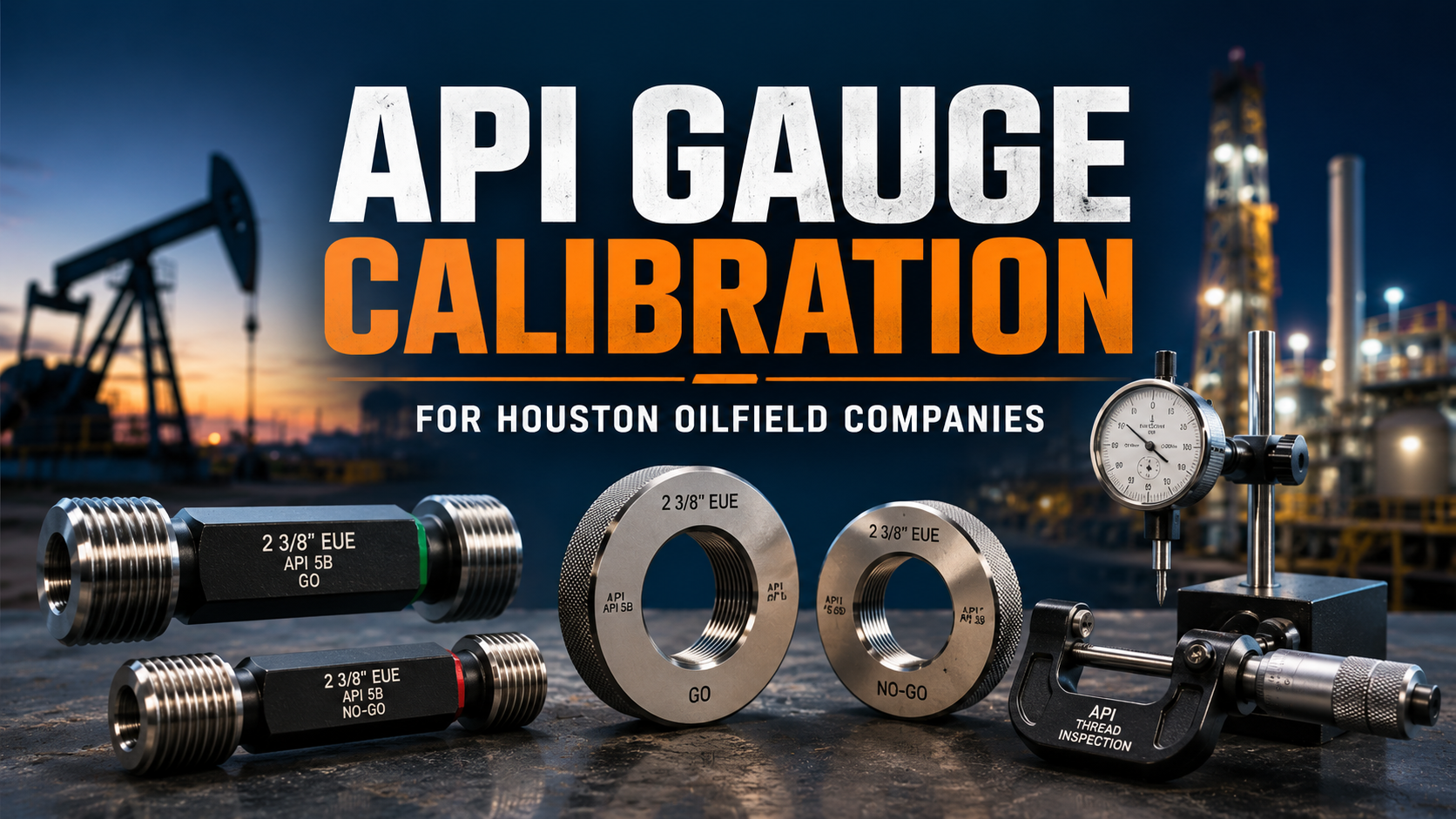
In Houston’s oilfield and energy services market, thread accuracy is not a small detail. It affects fit, sealing, inspection confidence, product acceptance, and field reliability.
That is why API gauge calibration is so important for companies that manufacture, inspect, repair, or handle casing, tubing, line pipe, couplings, and other threaded oilfield components.
API thread gauges are used to verify whether threaded products meet required specifications. When those gauges are worn, damaged, or out of calibration, the risk increases for rejected parts, failed inspections, customer disputes, and nonconforming product.
For Houston oilfield companies, a reliable API gauge calibration program helps protect quality, compliance, and customer confidence.
What Are API Gauges?
API gauges are precision inspection tools used to verify oilfield thread forms and connections. They are commonly associated with casing, tubing, line pipe, couplings, and other threaded components used in oil and gas applications.
API Spec 5B covers dimensions, tolerances, and marking requirements for API threads and the gauges that control acceptance criteria for those threads. It also includes thread element gauges, instruments, and requirements for inspecting line pipe, round thread casing, round thread tubing, and buttress casing connections.
Common API-related gauges and inspection tools may include:
- API plug gauges
- API ring gauges
- Thread element gauges
- Lead gauges
- Taper gauges
- Height gauges
- Buttress thread gauges
- Working gauges
- Reference gauges
- Setting standards
- Thread profile gauges
Because these tools are used to accept or reject threaded products, their accuracy matters.
Why API Gauge Calibration Matters
API gauges are often used in inspection environments where a small measurement issue can have a large effect. If a thread gauge is inaccurate, it can create problems throughout the quality process.
An out-of-calibration API gauge can lead to:
- Incorrect part acceptance
- Incorrect part rejection
- Rework and production delays
- Customer disputes
- Audit findings
- Loss of traceability
- Increased scrap
- Field performance concerns
- Unreliable inspection records
For oilfield companies, API gauge calibration is not just about passing an audit. It is about making sure inspection decisions are based on tools that can be trusted.
Houston Precision was established in 1993 as a local calibration lab for the Houston Energy Services Sector, making this a natural service area for local oilfield and industrial customers.
What Does API Gauge Calibration Verify?
During API gauge calibration, the gauge is inspected and compared against applicable standards or master gauges to determine whether it remains within required tolerances.
Depending on the gauge type, calibration may involve checking:
- Pitch diameter
- Lead
- Taper
- Thread height
- Stand-off
- Profile
- Wear
- Damage
- Markings
- Fit or mating condition
- Overall condition
- Measurement repeatability
The exact process depends on the gauge type, applicable specification, customer requirements, and whether the tool is a working gauge, master gauge, or thread element inspection tool.
For companies working under API Spec 5B requirements, gauge control and inspection records should be treated as a critical part of the quality system.
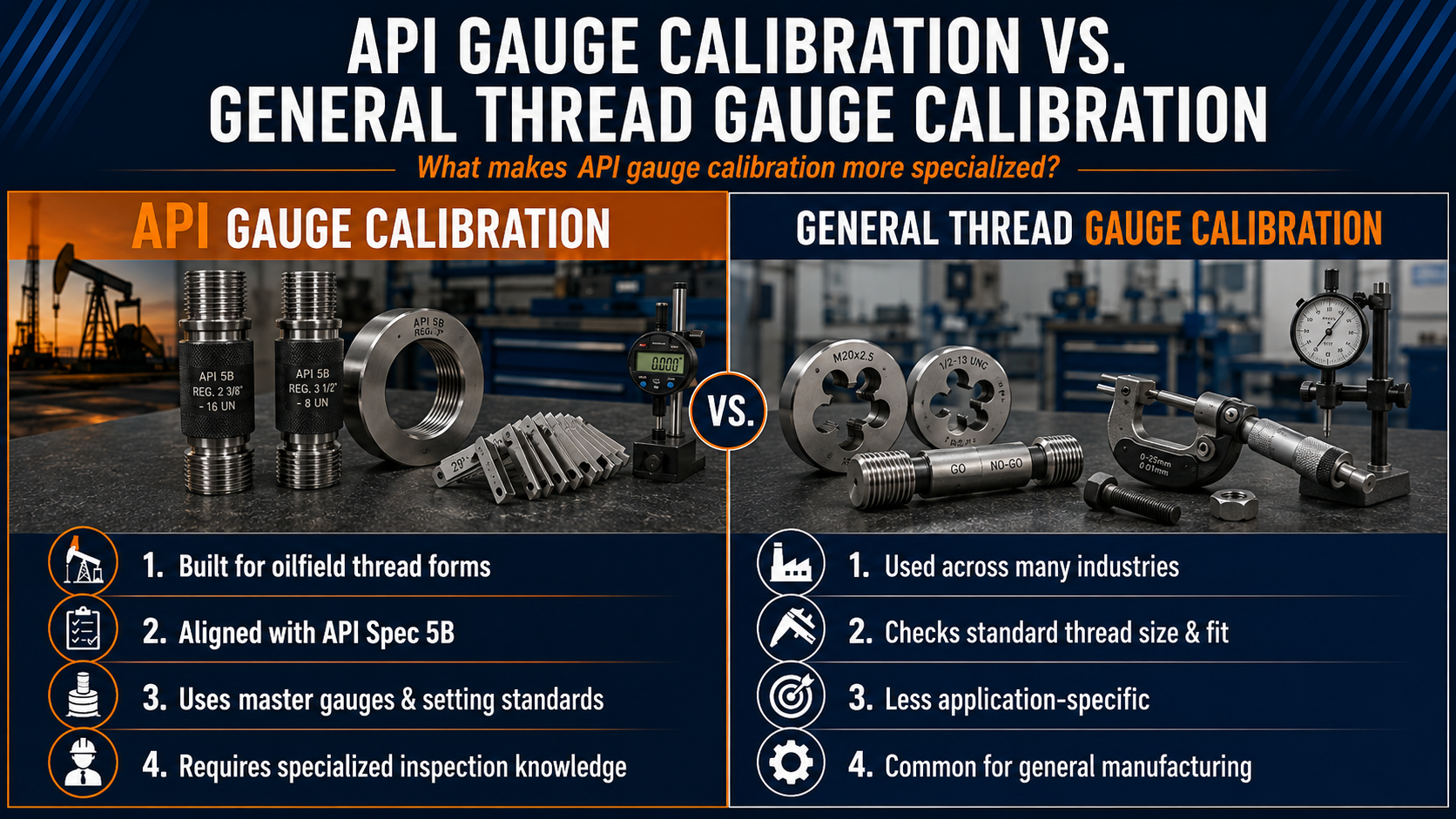
API Gauge Calibration vs. General Thread Gauge Calibration
API gauge calibration is related to thread gauge calibration, but it is more specialized.
General thread gauges are used across many industries to check thread size and fit. API gauges are tied to oilfield thread specifications and are often used in applications involving casing, tubing, line pipe, and buttress connections.
That means API gauge calibration may involve specialized knowledge of:
- Oilfield thread forms
- API Spec 5B requirements
- Plug and ring gauge relationships
- Working gauge wear
- Master gauge comparison
- Thread element measurements
- Oilfield inspection practices
- Documentation expectations
For Houston oilfield companies, choosing a calibration provider familiar with API gauges and oilfield requirements can help reduce risk and improve inspection confidence.
How Often Should API Gauges Be Calibrated?
There is no single interval that fits every API gauge in every shop. The right calibration frequency depends on use, condition, application risk, customer requirements, and quality system requirements.
Many companies use a 12-month calibration interval as a starting point. However, some API gauges should be calibrated more often.
Consider a shorter interval if the gauge is:
- Used daily or across multiple shifts
- Used for final acceptance inspection
- Used on high-value or critical components
- Exposed to shop-floor damage, dirt, oil, or corrosion
- Frequently transported between locations
- Used by multiple inspectors
- Showing signs of wear
- Previously found out of tolerance
- Required by customer contract or internal quality procedure
For high-use API working gauges, a 3- to 6-month interval may be more appropriate than an annual schedule.
The best approach is to review calibration history over time. Gauges that repeatedly pass with no issues may support the current interval. Gauges that fail, drift, or show wear should be reviewed more often.
Signs an API Gauge Needs Calibration Now
Do not wait for the next due date if an API gauge appears questionable.
Schedule calibration immediately if:
- The gauge was dropped
- Threads are visibly worn or damaged
- The gauge is difficult to use or does not fit as expected
- Inspectors are getting inconsistent results
- A customer disputes inspection results
- The gauge has corrosion or contamination
- The gauge was exposed to impact or mishandling
- The gauge was used on suspect or damaged parts
- The gauge has missing or unclear markings
- A related master or setting standard has changed
A calibration due date should be treated as the latest acceptable date, not the only time the gauge should be checked.
Working Gauges, Master Gauges, and Setting Standards
Oilfield quality teams often use more than one level of gauge control.
A working gauge is used regularly during inspection or production. Because it is handled often, it is more likely to wear or be damaged.
A master gauge or reference standard is used to verify or set working gauges. It is generally handled more carefully and used less frequently.
A setting standard may be used to set or verify certain thread element gauges.
Each type of gauge should have a defined role in the quality system. Working gauges usually face the most wear and may need more frequent calibration. Master gauges and setting standards should be protected, controlled, and calibrated according to their importance and usage.
What Happens If an API Gauge Fails Calibration?
If an API gauge fails calibration, remove it from service immediately until the issue is reviewed.
The quality team should determine:
- How far out of tolerance the gauge was
- Whether the gauge can be adjusted or repaired
- Whether any parts may have been affected
- When the gauge was last known to be acceptable
- Which jobs, lots, or inspections used the gauge
- Whether customer notification or internal review is needed
- Whether the calibration interval should be shortened
- Whether the gauge should be replaced
A failed API gauge may create a higher-risk situation than a general-use shop tool because it may have been used to accept or reject threaded oilfield components. The response should be documented clearly.
Repair or Replace: What Is the Better Option?
Some API gauges and thread element gauges may be repairable, while others are better replaced.
Repair or rework may be appropriate when:
- The gauge is valuable
- Damage is minor
- The gauge can be restored to tolerance
- The cost of repair is reasonable
- The gauge can be recalibrated after service
Replacement may be better when:
- Threads are heavily worn
- The gauge fails repeatedly
- Markings are missing or unreliable
- Damage affects inspection confidence
- The gauge is no longer economical to repair
- The gauge is needed for critical acceptance decisions
Houston Precision describes itself as a one-stop shop for quality instrument purchases and calibration needs and is a sister company of Deterco, Inc., a stocking supplier of API gauges, thread element gauges, and metrology measuring instruments.
For replacement or additional gauges, Deterco Online lists thread element specialty gauges for API, premium, and semi-premium thread forms, including lead gauges and buttress thread gauges.
If an API gauge is no longer economical to repair, you can shop API gauges and thread element gauges through Deterco Online.
API Gauge Calibration for Houston Oilfield Quality Programs
Houston oilfield companies often face demanding quality expectations. Customers may require documented calibration, traceability, inspection records, and clear procedures for gauge control.
A strong API gauge calibration program should include:
- A complete gauge inventory
- Unique gauge ID numbers
- Calibration due dates
- Defined calibration intervals
- Storage and handling procedures
- Records for failed or repaired gauges
- Traceability documentation
- Clear rules for removing tools from service
- Review of calibration history
- Training for inspectors and operators
API gauges should be treated as controlled inspection equipment, not general shop tools. When they are used to make acceptance decisions, their condition and calibration status matter.
Best Practices for Handling API Gauges
Proper care helps extend gauge life and reduce calibration failures.
Follow these best practices:
- Keep gauges clean and lightly protected from corrosion
- Store plug and ring gauges in protective cases
- Avoid dropping, stacking, or striking gauges
- Do not force a gauge into a damaged or dirty thread
- Clean threads before inspection
- Keep gauges away from extreme heat or moisture
- Train inspectors on proper use
- Separate working gauges from master gauges
- Remove questionable gauges from service immediately
- Track wear patterns and recurring failures
A good handling program can help oilfield quality teams reduce risk and improve inspection consistency.
Lab Calibration vs. Onsite Support for API Gauges
Most API gauges are good candidates for lab calibration because they are precision tools that benefit from controlled handling, specialized standards, and detailed inspection.
Lab calibration is often best for:
- API plug gauges
- API ring gauges
- Thread element gauges
- Lead gauges
- Taper gauges
- Setting standards
- Gauges that may require detailed inspection or repair
Houston Precision provides lab gage and instrument services in a climate-controlled Polk Street laboratory, where technicians repair and calibrate precision instruments to factory-specified tolerances.
Onsite support may still be useful for larger inspection systems, measuring equipment, or related production environments. Houston Precision offers both lab and onsite calibration services for eligible equipment and instruments.
Choosing an API Gauge Calibration Partner in Houston
When selecting a calibration provider, oilfield companies should look for more than convenience.
A strong calibration partner should understand:
- API gauge applications
- Oilfield inspection requirements
- Thread gauge control
- Calibration documentation
- Repair and replacement decisions
- Traceability expectations
- Turnaround needs for production teams
- Local Houston energy service demands
Houston Precision is located in Houston, Texas, and provides repair and calibration service for industrial customers, including lab, onsite, and CMM-related services.
For oilfield companies that also need replacement gauges or measuring instruments, Houston Precision’s relationship with Deterco creates a natural path from calibration review to product replacement when needed.
API Gauge Calibration Checklist
Use this checklist to strengthen your gauge control program:
- Create a complete list of API gauges.
- Assign each gauge a unique ID.
- Record gauge type, size, range, and specification.
- Set a baseline calibration interval.
- Separate working gauges from master gauges.
- Store gauges in protective cases.
- Train inspectors on proper gauge use.
- Remove damaged or questionable gauges from service.
- Review failed calibration reports.
- Adjust calibration intervals based on use and history.
- Replace worn or unreliable gauges.
- Keep calibration records audit-ready.
This process helps turn API gauge calibration from a reactive task into a controlled quality program.
Need API Gauge Calibration in Houston?
Houston Precision supports Houston oilfield companies with calibration, repair, and metrology services for precision instruments and inspection equipment.
If your API gauges, thread element gauges, or oilfield inspection tools are due for calibration, Houston Precision can help you review your instrument list, manage calibration records, and determine whether repair or replacement is the right next step.
Request a quote today for API gauge calibration in Houston.