
But as with a people-exam, the main reason for the annual check-up is to prevent problems from occurring in the first place.
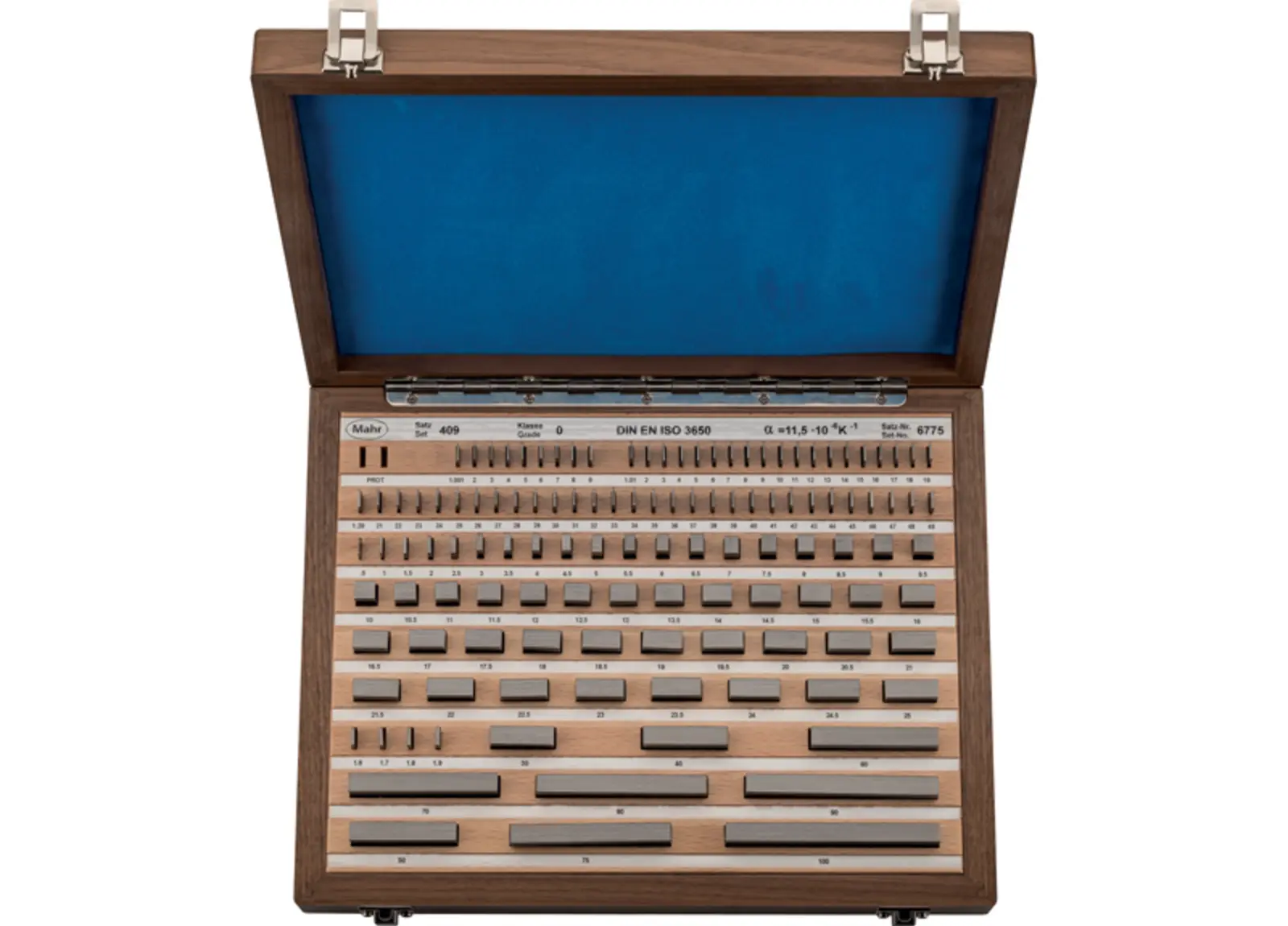
The accuracy of a gage can only be known by reference to a higher standard. Thus, gages are set to masters that are more accurate than the gage. These masters are certified against gage blocks produced to a higher standard of accuracy, ultimately traceable to nationally or internationally recognized “absolute” standards that define the size of the dimensional unit. This is the line of traceability, which must be followed for calibration to be valid.
Calibration is used to determine how closely a gage adheres to the standard. When applied to a master ring, disc, or a gage block, it reveals the difference between the nominal and the actual sizes. When applied to a measuring instrument such as a comparator, calibration reveals the relationship between gage input and output, in other words, the difference between the actual size of the part and what the gage says it is.
Gages go out of calibration through normal usage: parts wear, and mechanisms become contaminated. A gage may have a design flaw, so that joints loosen frequently and the gage becomes incapable of holding calibration. Accidents and rough handling also put gages out of calibration.
No gage, therefore, can be relied upon if it has not been calibrated, or if its calibration history is unknown. Annual calibration is considered the minimum, but for gages that are used in demanding environments, gages that are used by several operators or for many different parts, and gages used in high-volume applications, shorter intervals are needed. Frequent calibration is also required when gaging parts that will be used in critical applications, and where the cost of being wrong is high.
Large companies that own hundreds or thousands of gages sometimes have their own calibration departments, but this is rarely an economical option for machine shops. In addition to specialized equipment, in-house calibration programs require a willingness to devote substantial employee resources to the task.
Calibration service providers are usually a more economical approach. Smaller gages can be shipped to the provider, while large instruments must be checked in-place. Calibration houses also help shops by maintaining a comprehensive calibration program, to ensure that every gage in the facility is checked according to schedule, and that proper records are kept.
General guidelines for instrument calibration procedures appear in the ISO & ANZI standards. While every gage has its own specific procedures which are outlined in the owner’s manual, calibration procedures also must be application specific. In other words, identical gages that are used in different ways may require different procedures.
For example, if a gage is used only to confirm that parts fall within a tolerance band, it may be sufficient to calibrate it only at the upper and lower tolerance limits. On the other hand, if the same gage is used to collect data for SPC, and the accuracy of all measurements is important, then simple calibration might be insufficient, and a test of linearity over the entire range might be needed.
The conditions under which calibration occurs should duplicate the conditions under which the gage is used. Calibration in a high-tech gaging lab may be misleading if the gage normally lives next to a blast furnace. Similarly, a snap gage that is normally used to measure round parts should be calibrated against a master disc or ring, and not with a gage block. The gage block could produce misleading results by bridging across worn areas on gage contacts, while a round master would duplicate the actual gaging conditions and produce reliable results.
Before calibration begins, therefore, the technician should be provided with a part print and a description of the gaging procedure. Next, he should check the calibration record, to confirm that the instrument serial number and specifications agree with the instrument at hand. The gage will then be cleaned and visually inspected for burrs, nicks, and scratches. Defects must be stoned out, and mechanisms checked for freedom of movement. If the instrument has been moved from another area, it must be given time to stabilize.
All of these measures help ensure that calibration will be accurate, but this must not lead to a false sense of security: gage calibration will not eliminate all measuring errors. As we have seen before, gaging is not simply hardware: it is a process. Calibration lends control over the instrument and the standard or master, but gage users must continue to seek control over the environment, the workpiece, and the gage operator.