
Coordinate measuring machines, commonly known as CMMs, play a critical role in precision inspection. For manufacturers, machine shops, aerospace suppliers, energy companies, and quality departments, a CMM can be one of the most important pieces of inspection equipment in the building.
When a CMM is working correctly, it helps verify part dimensions, confirm tolerances, support production decisions, and maintain customer confidence. When it is not working correctly, the impact can be serious. Inspection delays, questionable measurement results, rejected parts, downtime, and customer disputes can all follow.
Two common service needs are CMM calibration and CMM repair.
They are related, but they are not the same thing.
CMM calibration verifies whether the machine is measuring accurately. CMM repair addresses mechanical, electrical, software, probe, or performance problems that prevent the machine from operating correctly.
Understanding the difference helps quality teams know when to schedule routine service, when to troubleshoot a problem, and when a CMM needs deeper technical support.
What Is a CMM?
A coordinate measuring machine is a measurement system used to inspect the physical geometry of a part. A CMM typically uses a probe attached to a moving axis system to collect measurement points from a part. CMMs may be manually controlled or computer controlled, and probes can include mechanical, optical, laser, or white-light technologies.
CMMs are commonly used to inspect:
- Machined components
- Castings
- Molded parts
- Aerospace components
- Oilfield and energy parts
- Automotive components
- Tooling and fixtures
- First articles
- Production parts
- Reverse-engineered parts
Because CMMs are used to make important inspection decisions, both machine accuracy and system reliability matter.
What Is CMM Calibration?
CMM calibration is the process of verifying that the CMM is measuring within required accuracy specifications.
During calibration, a technician checks the machine against known standards and evaluates whether the system is producing reliable measurement results. The goal is to determine whether the machine is acceptable for inspection work and whether its results can be trusted.
CMM calibration may include checks related to:
- Machine geometry
- Linear accuracy
- Volumetric accuracy
- Repeatability
- Probe performance
- Axis movement
- Squareness
- Scale performance
- Environmental conditions
- Measurement uncertainty
- System documentation
Calibration is usually a planned, preventive service. It is part of a quality program and is often required for audits, customer requirements, and internal inspection control.
Houston Precision’s CMM Service Division includes CMM calibrations, diagnostics, repair, part programming, reverse engineering, software upgrades, CMM retrofits, relocation, parts, and contract services.
What Is CMM Repair?
CMM repair addresses a problem with the machine, software, probe system, controls, or related components.
Repair is usually needed when the CMM is not working properly, producing questionable results, failing to move correctly, showing errors, or causing downtime.
CMM repair may involve:
- Troubleshooting error messages
- Diagnosing probe issues
- Repairing mechanical problems
- Resolving scale or encoder issues
- Fixing axis movement problems
- Addressing air supply or bearing issues
- Repairing control system problems
- Resolving software or communication issues
- Replacing damaged components
- Correcting repeatability problems
- Restoring machine performance
Repair is often reactive, although some issues can be found during preventive service or calibration.
Houston Precision lists CMM diagnostics and CMM repair as part of its CMM Service Division, along with calibration, programming, reverse engineering, software upgrades, retrofits, relocation, parts, and contract services.
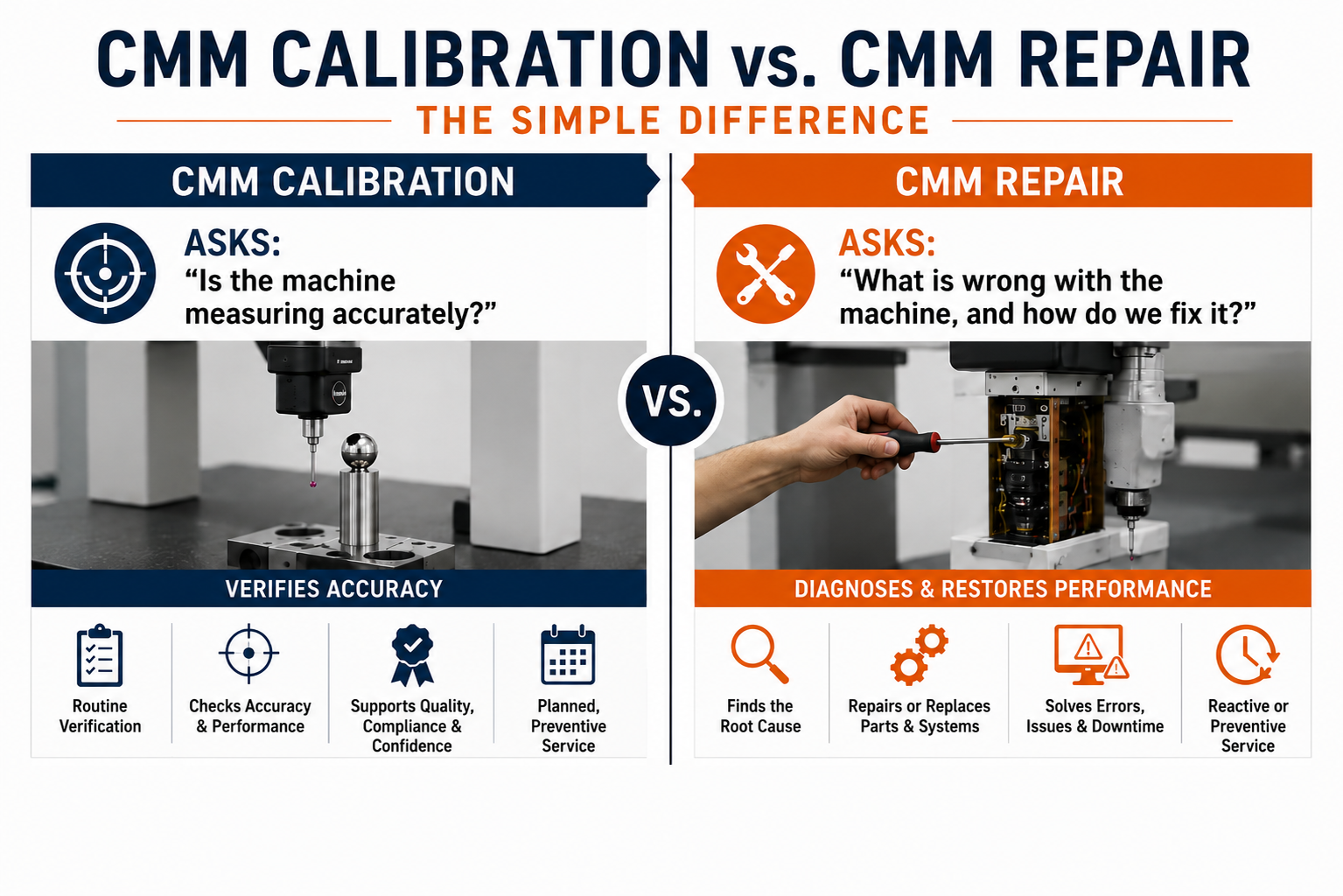
CMM Calibration vs. CMM Repair: The Simple Difference
The easiest way to understand the difference is this:
CMM calibration asks:
“Is the machine measuring accurately?”
CMM repair asks:
“What is wrong with the machine, and how do we fix it?”
A CMM can need calibration even if it seems to be working normally. A CMM can need repair when it is not functioning correctly, even if it is not yet due for calibration.
| Situation | Likely Service Needed |
|---|---|
| Machine is due for scheduled verification | CMM calibration |
| Machine was moved or relocated | CMM calibration, possibly service review |
| Measurement results are drifting | Calibration and diagnostics |
| Machine will not home properly | CMM repair |
| Probe is not triggering correctly | CMM repair or probe service |
| Software communication errors appear | CMM diagnostics or repair |
| Machine crashes or has impact damage | CMM repair, then calibration |
| Inspection results do not match known standards | Calibration and diagnostics |
| Machine has been retrofitted or upgraded | Calibration after service |
| CMM is being prepared for audit support | CMM calibration |
When Do You Need CMM Calibration?
CMM calibration is typically needed when the machine is due for scheduled verification, has been moved, or must be confirmed for accuracy.
Schedule CMM calibration when:
- The CMM is due based on your calibration interval
- The machine has been relocated
- The machine has been repaired
- A probe system has been changed
- A retrofit or software upgrade has been completed
- Inspection results seem inconsistent
- A customer or auditor requires updated calibration records
- The machine has experienced a crash or impact
- Environmental conditions have changed
- The CMM is used for critical inspection work
Even if the machine appears to run normally, calibration helps confirm that its measurement results remain reliable.
When Do You Need CMM Repair?
CMM repair is needed when the machine is not functioning as expected.
Schedule repair or diagnostics when:
- The machine will not start or initialize
- The CMM will not home correctly
- Axis movement is rough, noisy, or inconsistent
- The probe does not trigger reliably
- The machine shows recurring errors
- Software cannot communicate with the machine
- Measurements are unstable or non-repeatable
- The CMM has crashed into a part or fixture
- Air pressure or bearing problems are suspected
- The machine stops during inspection routines
- A joystick, controller, scale, or drive issue appears
- The CMM cannot complete a program successfully
If a CMM has a mechanical, probe, software, or control problem, calibration alone may not solve it. The issue needs to be diagnosed and corrected first.
Why Calibration Usually Follows Repair
If a CMM is repaired, it usually needs calibration before being returned to full inspection service.
That is because repairs can affect machine geometry, probing performance, axis motion, or measurement accuracy. Even when the repair fixes the immediate problem, the quality team still needs confidence that the machine measures correctly.
A common sequence looks like this:
- Diagnose the CMM issue.
- Repair or replace the affected component.
- Verify basic machine function.
- Perform CMM calibration.
- Review documentation.
- Return the machine to inspection use.
This sequence helps protect quality records and reduces the chance that a repaired machine is returned to service without proper verification.
Common Signs Your CMM May Be Out of Calibration
A CMM can be out of calibration without completely failing. Watch for signs such as:
- Measurement results no longer match known parts or standards
- Different operators get different results
- Inspection data drifts over time
- Repeatability gets worse
- Parts fail inspection unexpectedly
- Previously stable programs produce new variation
- Results do not match other verified inspection equipment
- The machine has recently been moved
- The machine was exposed to temperature swings or vibration
- A probe crash occurred
These symptoms may point to calibration needs, machine issues, programming issues, fixture problems, or environmental factors. A qualified CMM technician can help determine the cause.
Common Signs Your CMM Needs Repair
A repair issue is usually more obvious than a calibration issue, but not always.
Signs of possible CMM repair needs include:
- The machine will not power on
- The machine will not home
- Axes move unevenly
- The probe does not trigger correctly
- The CMM stops during a program
- Error messages repeat
- Air supply alarms appear
- The machine makes unusual noise
- The joystick or controls do not respond properly
- Scale, encoder, or communication errors appear
- The machine was physically damaged
- Software cannot connect to the controller
If these problems appear, it is best to stop using the machine until the issue is diagnosed.
CMM Diagnostics: The Bridge Between Calibration and Repair
Sometimes the problem is not obvious. The CMM may be producing inconsistent results, but the cause could be mechanical, environmental, software-related, probing-related, or programming-related.
That is where CMM diagnostics become important.
Diagnostics can help determine whether the issue is caused by:
- Machine geometry
- Probe performance
- Air or bearing systems
- Scales or encoders
- Controller communication
- Software settings
- Part fixturing
- Program logic
- Operator technique
- Environmental conditions
Houston Precision specifically lists diagnostics as part of its CMM Service Division.
CMM Programming, Software, and Retrofits
CMM service is not limited to calibration and repair. Many quality teams also need support with programming, software, upgrades, retrofits, relocation, and contract inspection work.
Houston Precision’s CMM Service Division lists part programming, reverse engineering, software upgrades, CMM retrofits, relocation, parts, repairs, and contract services among its capabilities.
This matters because many CMM problems are not purely mechanical. Sometimes the machine is functional, but the inspection program, software setup, probe configuration, or reporting process needs improvement.
CMM support may be helpful when:
- A new part needs inspection programming
- Existing programs need updates
- A software platform changes
- A probe system is upgraded
- The CMM needs to be moved
- A legacy machine needs a retrofit
- The quality team needs temporary contract support
- Inspection reports need to be improved
What Information Should You Provide for a CMM Service Quote?
Providing the right information helps speed up service and makes troubleshooting easier.
Houston Precision’s CMM quote form requests details such as the CMM manufacturer, model, serial number, software version, probe system model, and a description of the problem or issue.
Before requesting service, gather:
- CMM manufacturer
- CMM model
- Serial number
- Machine size or measuring range
- Software platform and version
- Probe system model
- Controller information, if available
- Error messages or screenshots
- Description of the issue
- Recent crash, move, repair, or software change
- Calibration due date
- Urgency or production impact
The more detail you provide, the easier it is to determine whether you need calibration, repair, diagnostics, programming, or another service.
Brands and Software Platforms Matter
CMM service experience matters because machines, controllers, software, and probe systems vary widely.
Houston Precision lists experience with CMM brands and systems including Zeiss, Brown & Sharpe, Sheffield, Starrett, LK, Wenzel, Mitutoyo America, Hexagon, DEA, FARO Arm, ROMER Arm, and more. It also lists software platforms such as Calypso, PC-DMIS, Modus, CMM Manager, MeasureMax, Camio, MCOSMOS, GeoMeasure, and PolyWorks Inspector.
That range is important for Houston companies with mixed equipment or legacy systems. A facility may have more than one CMM brand, multiple software platforms, or older equipment that still supports production.
Should You Repair, Retrofit, or Replace a CMM?
Not every CMM issue should be handled the same way. Sometimes repair is the right choice. In other situations, a retrofit or replacement may offer better long-term value.
Consider repair when:
- The machine structure is sound
- The issue is isolated
- Replacement parts are available
- The CMM still meets inspection needs
- Downtime can be minimized
- Repair cost is reasonable
Consider retrofit when:
- The machine frame is good but controls are outdated
- Software support is limited
- Probe technology needs improvement
- Reporting or programming needs have changed
- The CMM needs better performance without full replacement
Consider replacement when:
- The machine is unreliable
- Repair costs are rising
- Parts are difficult to source
- Accuracy no longer meets requirements
- The machine is too small or slow for current work
- The quality team needs newer capabilities
For teams exploring replacement or additional CMM equipment, Deterco Online lists CMM coordinate measuring machine systems, including CNC, manual, in-line, and pre-owned CMM categories.
If repair or retrofit no longer makes sense, you can review CMM systems and accessories through Deterco Online.
How Often Should a CMM Be Calibrated?
Many companies schedule CMM calibration annually, but the right interval depends on usage, risk, environment, customer requirements, and calibration history.
A CMM may need more frequent calibration if it is:
- Used heavily
- Used across multiple shifts
- Used for final acceptance inspection
- Located in a less controlled environment
- Used for tight-tolerance parts
- Recently moved or repaired
- Subject to vibration or temperature changes
- Showing unstable or questionable results
- Required by customer or audit expectations
The calibration interval should be documented and reviewed over time. If the machine repeatedly shows problems, the interval may need to be shortened or the environment may need to be improved.
Why Houston Companies Need Reliable CMM Service
Houston manufacturers and energy service companies often work with high-value parts, tight tolerances, and demanding customer requirements. When a CMM is down or producing questionable results, production and quality workflows can slow quickly.
Reliable CMM service helps companies:
- Reduce inspection downtime
- Maintain measurement confidence
- Support audits and customer requirements
- Improve part inspection consistency
- Extend equipment life
- Troubleshoot recurring issues
- Plan repairs, upgrades, or replacement
- Keep production and quality teams aligned
Houston Precision provides lab gage and instrument services, onsite calibration services, and CMM services, with onsite technicians available in Houston, San Antonio, and Monterrey, Mexico.
Need CMM Calibration or CMM Repair in Houston?
Houston Precision provides CMM calibration, diagnostics, repair, part programming, reverse engineering, software upgrades, retrofits, relocation, parts, and contract services for Houston-area quality teams and manufacturers.
Whether your CMM is due for calibration, producing questionable results, showing errors, or needs a repair review, Houston Precision can help determine the right next step.
Request a quote today to schedule CMM calibration, diagnostics, or repair service in Houston.
FAQs
What is the difference between CMM calibration and CMM repair?
CMM calibration verifies whether the machine is measuring accurately. CMM repair fixes mechanical, electrical, probe, control, software, or performance problems that prevent the machine from operating correctly.
Does a CMM need calibration after repair?
Usually, yes. After a CMM is repaired, calibration helps confirm that the machine is measuring accurately before it is returned to inspection service.
How do I know if my CMM needs repair?
Your CMM may need repair if it will not home, shows recurring errors, moves unevenly, has probe issues, loses communication with software, stops during programs, or produces unstable results.
How often should a CMM be calibrated?
Many companies calibrate CMMs annually, but the right interval depends on usage, risk, environment, customer requirements, and calibration history. Machines used heavily or for critical inspection may require more frequent verification.
What information is needed for a CMM service quote?
Useful information includes the CMM manufacturer, model, serial number, software version, probe system model, controller details, error messages, recent crash or move history, and a description of the issue.
Does Houston Precision provide CMM programming and retrofits?
Yes. Houston Precision’s CMM Service Division includes part programming, reverse engineering, software upgrades, CMM retrofits, relocation, parts, repairs, and contract services.