
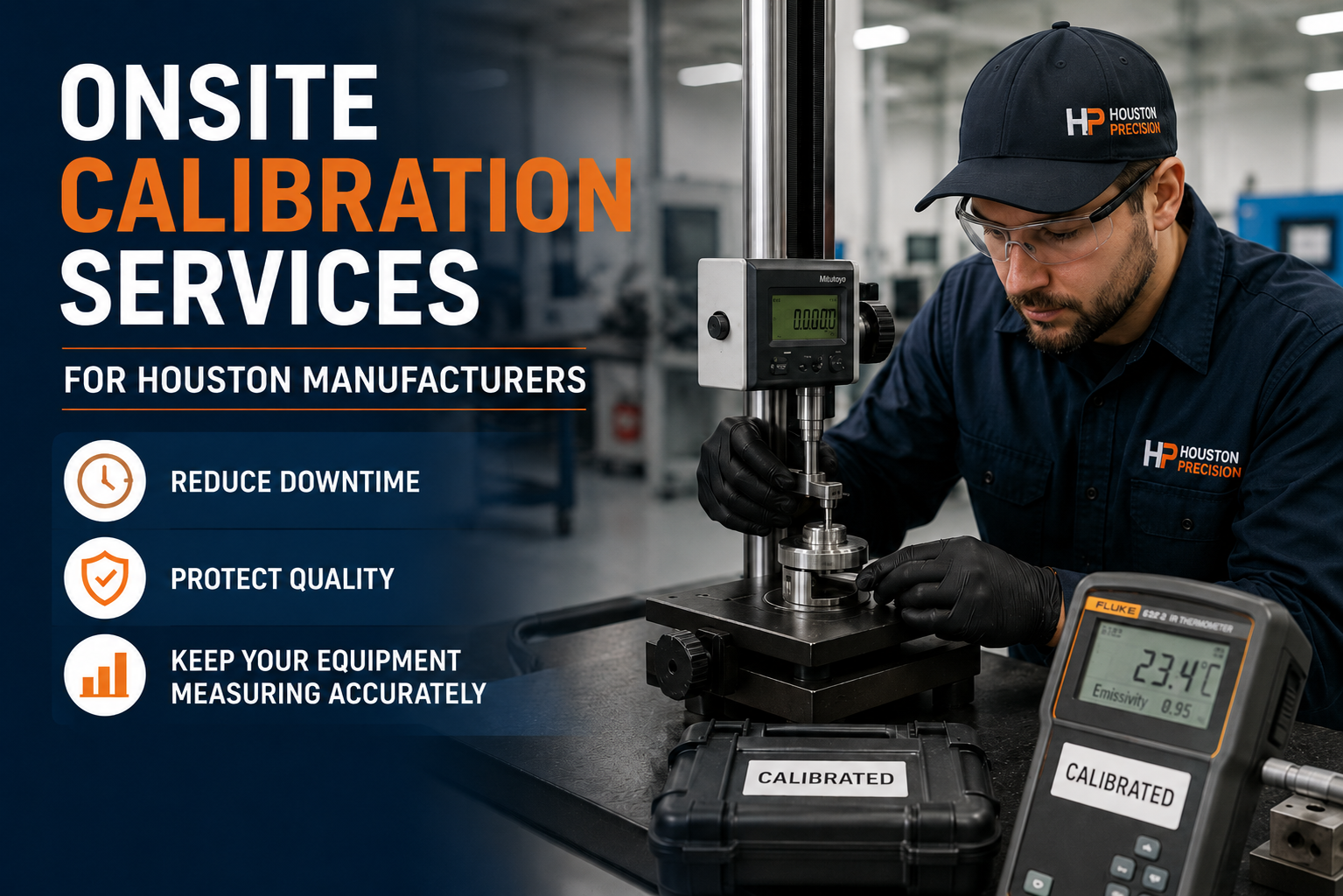
For Houston manufacturers, downtime is expensive. When inspection equipment, measuring systems, or production-critical instruments are taken out of service, the impact can move quickly through the shop floor. Jobs slow down. Inspections back up. Quality teams lose flexibility. Production schedules become harder to manage.
That is why many companies choose onsite calibration services for equipment that is too large, too sensitive, too busy, or too important to send out.
Instead of removing equipment from your facility, onsite calibration brings the technician to your plant, shop, inspection area, or quality lab. For eligible equipment, this can help reduce downtime, simplify scheduling, and keep your measurement program moving.
For manufacturers in Houston and the Gulf Coast, onsite calibration can be a practical way to protect quality without creating unnecessary disruption.
What Is Onsite Calibration?
Onsite calibration is calibration performed at the customer’s facility instead of at a calibration laboratory. A technician visits your location, checks eligible equipment against appropriate standards, documents the results, and helps determine whether the equipment remains within the required tolerance.
Houston Precision provides onsite calibration services at customer locations and also provides lab gauge and instrument services in a climate-controlled Polk Street laboratory.
Onsite calibration is often used for large, fixed, or difficult-to-move equipment. It can also be helpful when a company has many instruments due at the same time and wants to streamline the calibration process.
Why Onsite Calibration Matters for Houston Manufacturers
Houston manufacturers often work with tight production timelines, demanding customer requirements, and inspection equipment that supports daily operations. In those environments, calibration is not just a documentation requirement. It is part of keeping the business running.
Onsite calibration can help manufacturers:
- Reduce equipment downtime
- Avoid shipping or transportation risks
- Keep large inspection systems in place
- Support production schedules
- Maintain calibration records
- Improve tool-control efficiency
- Reduce disruption to quality teams
- Keep inspection workflows moving
For companies that rely on optical comparators, measuring systems, CMMs, roughness testers, IR thermometers, or other inspection equipment, onsite service can be especially valuable.
Equipment That May Be a Good Fit for Onsite Calibration
Not every instrument should be calibrated onsite. Small hand tools and precision instruments are often better handled in a controlled lab environment. However, larger inspection systems and production-critical equipment are often strong candidates for onsite service.
Houston Precision’s onsite service page lists onsite or lab support for black body calibration service, super micrometer service, IR thermometer calibration, laser calibration service, roughness testers, optical comparators, and measuring systems.
Common onsite calibration candidates include:
- Optical comparators
- Measuring systems
- Super micrometers
- Surface roughness testers
- IR thermometers
- Black body calibration systems
- Laser calibration systems
- Large inspection equipment
- Production-critical measuring equipment
- CMMs and related inspection systems
Houston Precision also provides CMM services including calibrations, diagnostics, CMM repair, part programming, reverse engineering, software upgrades, retrofits, relocation, parts, and contract services.
Benefits of Onsite Calibration Services
Onsite calibration can be a smart choice for manufacturers that need reliable measurements without unnecessary downtime.
1. Less Downtime
When equipment stays at your facility, your team avoids the delays involved with packing, shipping, receiving, reinstalling, and requalifying equipment.
This is especially helpful when the equipment is used daily by production or quality teams.
2. Reduced Risk of Equipment Damage
Large measuring systems and inspection equipment can be difficult to move safely. Transporting sensitive equipment may create risk of damage, alignment issues, or additional service needs.
Onsite calibration helps reduce handling and transportation risk.
3. Better Support for Production-Critical Equipment
Some equipment is too important to take offline for long. If a comparator, CMM, measuring system, or roughness tester supports active production, onsite service may help minimize interruption.
4. More Convenient Scheduling
For companies with multiple instruments due around the same time, onsite calibration can simplify scheduling. Instead of coordinating multiple shipments or drop-offs, your team can plan a service visit around operational needs.
5. Real-World Equipment Review
Because onsite calibration happens where the equipment is used, the technician may also identify environmental or setup issues that could affect measurement performance.
These may include:
- Vibration
- Temperature variation
- Equipment placement
- Operator access
- Power or air supply issues
- Cleanliness around the inspection area
- Software or setup concerns
This can help the quality team understand whether measurement issues are caused by the equipment itself or by the environment around it.
Onsite Calibration vs. Lab Calibration
Both onsite calibration and lab calibration have a place in a strong quality program.
Onsite calibration is usually best for large, fixed, sensitive, or production-critical equipment that is difficult to move.
Lab calibration is usually best for portable precision instruments, gages, hand tools, torque tools, and items that benefit from a controlled lab environment.
Houston Precision’s lab services page notes that its lab gage and instrument services are performed in a climate-controlled laboratory, with factory-trained technicians who repair and calibrate precision instruments to factory-specified tolerances.
A Houston manufacturer may use both service types. For example, hand tools and small gages may go to the lab, while larger measuring systems and inspection equipment are calibrated onsite.
| Situation | Best Fit |
|---|---|
| Calipers, micrometers, indicators, and small gages | Lab calibration |
| Equipment that may need detailed repair | Lab calibration |
| Large measuring systems | Onsite calibration |
| Optical comparators | Onsite calibration |
| Production-critical inspection equipment | Onsite calibration |
| CMMs and related systems | Specialized onsite/CMM service |
| Tools requiring a controlled environment | Lab calibration |
| High-volume calibration events | Onsite calibration may be more efficient |
When Should Manufacturers Choose Onsite Calibration?
Onsite calibration may be the right choice when removing equipment would create unnecessary risk, cost, or downtime.
Choose onsite calibration when:
- The equipment is large or difficult to move
- The equipment is tied to production or inspection workflows
- Shipping could damage or disrupt the system
- The equipment requires setup in its actual working environment
- Your team has multiple instruments due at one time
- Downtime must be minimized
- The equipment supports customer-critical work
- The instrument is part of a recurring onsite calibration program
If the equipment is small, portable, damaged, or likely to require bench repair, lab calibration may be the better choice.
How Often Should Onsite Equipment Be Calibrated?
Calibration intervals depend on the equipment, how often it is used, the environment, customer requirements, and your company’s quality system.
Many manufacturers use annual calibration as a starting point, but some equipment may require shorter intervals.
Consider more frequent calibration if equipment is:
- Used daily or across multiple shifts
- Used for final acceptance inspection
- Located in a harsh or variable environment
- Exposed to vibration, heat, dust, oil, or coolant
- Used on tight-tolerance or high-value parts
- Previously found out of tolerance
- Recently moved, repaired, or adjusted
- Required by customer or audit standards
For equipment with a stable history and lower risk, the existing interval may be appropriate. For equipment that fails calibration, drifts, or supports critical inspection, the interval should be reviewed.
Houston Precision’s onsite quote form asks for information such as manufacturer, model, serial number, dimensions, software version, problem description, and recall interval, which are all helpful details when evaluating onsite service needs.
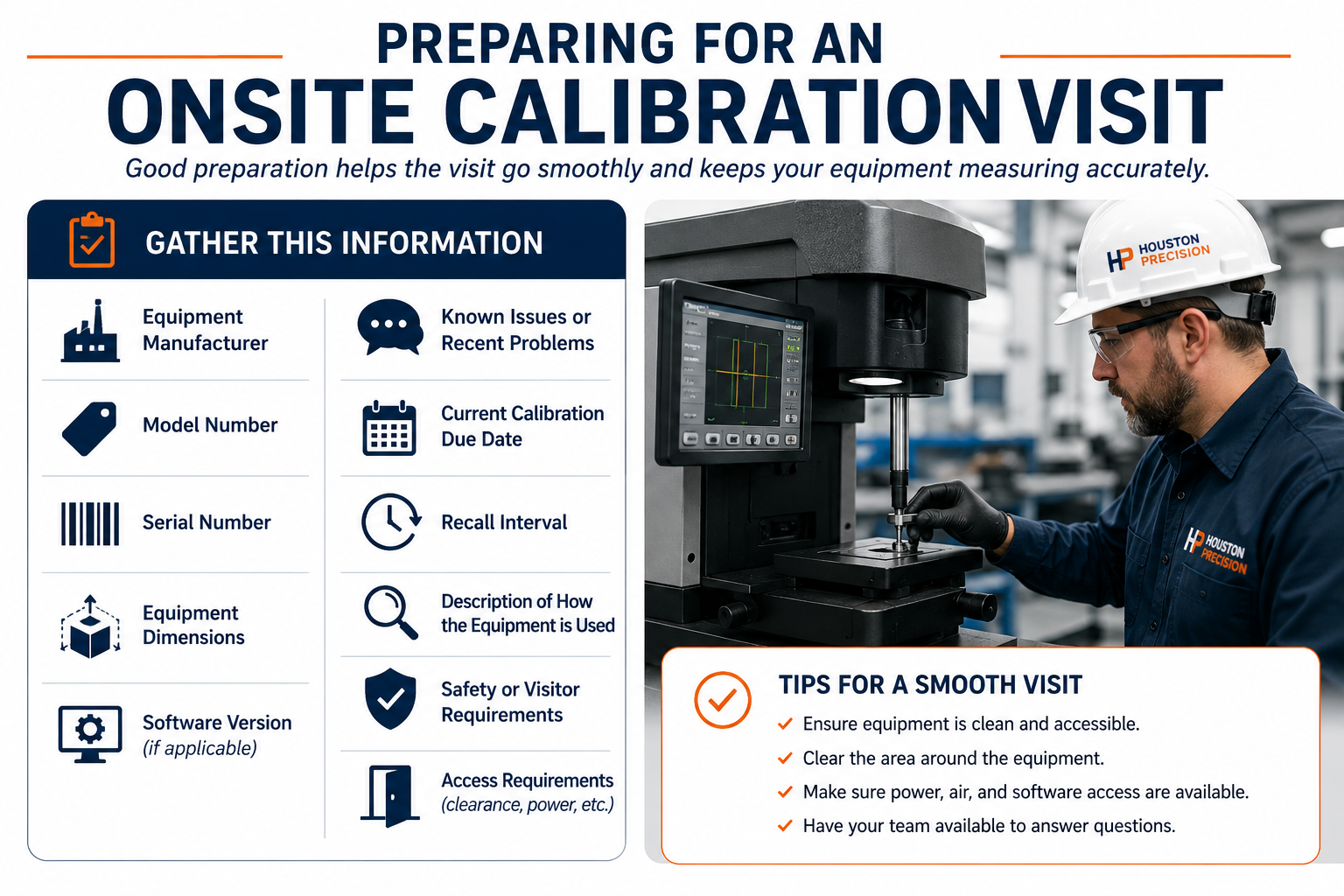
Preparing for an Onsite Calibration Visit
Good preparation helps the onsite visit go smoothly.
Before the technician arrives, gather:
- Equipment manufacturer
- Model number
- Serial number
- Equipment dimensions
- Software version, if applicable
- Current calibration due date
- Recall interval
- Known issues or recent problems
- Description of how the equipment is used
- Any customer or internal tolerance requirements
- Safety or visitor requirements
- Access requirements around the equipment
Houston Precision’s onsite quote form requests manufacturer, model, serial number, dimensions, software version if any, description of problem or issue, and recall interval.
Your team should also make sure the equipment is accessible, clean, powered if needed, and available during the scheduled service window.
What Happens During Onsite Calibration?
The exact process depends on the equipment being calibrated. However, most onsite calibration visits follow a similar structure.
A technician may:
- Review the equipment and identification details.
- Confirm the calibration scope.
- Inspect the equipment condition.
- Check setup, environment, or operating condition.
- Compare the equipment against appropriate standards.
- Record measurement results.
- Determine whether the equipment is within tolerance.
- Note any problems, limitations, or recommended next steps.
- Provide or update calibration documentation.
If equipment is found out of tolerance, the technician may recommend adjustment, repair, recalibration, restricted use, or replacement depending on the issue.
What If Equipment Fails Onsite Calibration?
If equipment fails onsite calibration, it should be reviewed before being returned to normal service.
The next step depends on the severity of the failure and the role of the equipment in your quality process.
Possible next steps include:
- Adjustment and recalibration
- Repair service
- CMM diagnostics, if applicable
- Restricted use
- Product impact review
- Shortened calibration interval
- Replacement planning
- Removal from service
For CMM-related issues, Houston Precision’s CMM Service Division includes diagnostics, CMM repair, part programming, software upgrades, retrofits, relocation, and contract services in addition to calibration.
Onsite Calibration for Quality and Audit Readiness
Calibration documentation is an important part of quality management. For many manufacturers, calibration records are reviewed during internal audits, customer audits, supplier reviews, and corrective action investigations.
A strong onsite calibration program should include:
- A current equipment list
- Unique equipment IDs
- Calibration due dates
- Defined recall intervals
- Calibration certificates or reports
- Out-of-tolerance records
- Repair and adjustment history
- Product impact review records when needed
- Clear responsibility for tool and equipment control
Houston Precision provides online access to calibration reports for active customers through its website.
How Onsite Calibration Supports Manufacturing Efficiency
Onsite calibration is not only about compliance. It can also support better manufacturing efficiency.
It helps quality teams:
- Plan calibration around production schedules
- Keep inspection equipment available
- Reduce shipping coordination
- Minimize delays from equipment removal
- Identify recurring equipment problems
- Improve measurement confidence
- Reduce risk of surprise failures
- Maintain better calibration visibility
For busy Houston manufacturers, those advantages can make onsite service a valuable part of the overall quality strategy.
When Replacement Equipment Makes More Sense
Sometimes calibration or repair is not the best long-term answer. If equipment is repeatedly failing, difficult to service, no longer accurate enough, or too costly to maintain, replacement may be the better option.
Replacement may make sense when:
- Equipment repeatedly fails calibration
- Repair costs are rising
- Parts are difficult to find
- Accuracy no longer meets requirements
- Software or controls are outdated
- Current equipment no longer supports production needs
- Downtime risk is becoming too high
For companies evaluating replacement tools or inspection equipment, Deterco Online lists a wide range of metrology and quality-control categories, including calipers, bore gauges, calibration master instruments, CMM systems, granite surface plates, hardness testers, height gauges, handheld process calibrators, surface roughness testers, thread element gauges, and other industrial measuring products.
If equipment is no longer economical to repair or calibrate, you can review quality control and metrology products through Deterco Online.
Choosing an Onsite Calibration Partner in Houston
A strong onsite calibration partner should understand both measurement accuracy and manufacturing uptime.
Look for a provider that can support:
- Lab and onsite calibration
- Large measuring systems
- Optical comparators
- Roughness testers
- IR thermometer systems
- CMM service and diagnostics
- Calibration documentation
- Repair recommendations
- Recurring calibration programs
- Houston-area manufacturing needs
Houston Precision provides lab gage and instrument services, onsite calibration services, CMM services, and in-house/on-site training classes for manufacturing and quality personnel.
Need Onsite Calibration Services in Houston?
Houston Precision provides onsite calibration services for eligible equipment and instruments at customer locations, along with lab calibration, CMM service, instrument repair, and metrology support for Houston-area manufacturers.
Whether your team needs onsite service for large inspection equipment, measuring systems, optical comparators, roughness testers, or related equipment, Houston Precision can help you determine the right calibration approach.