
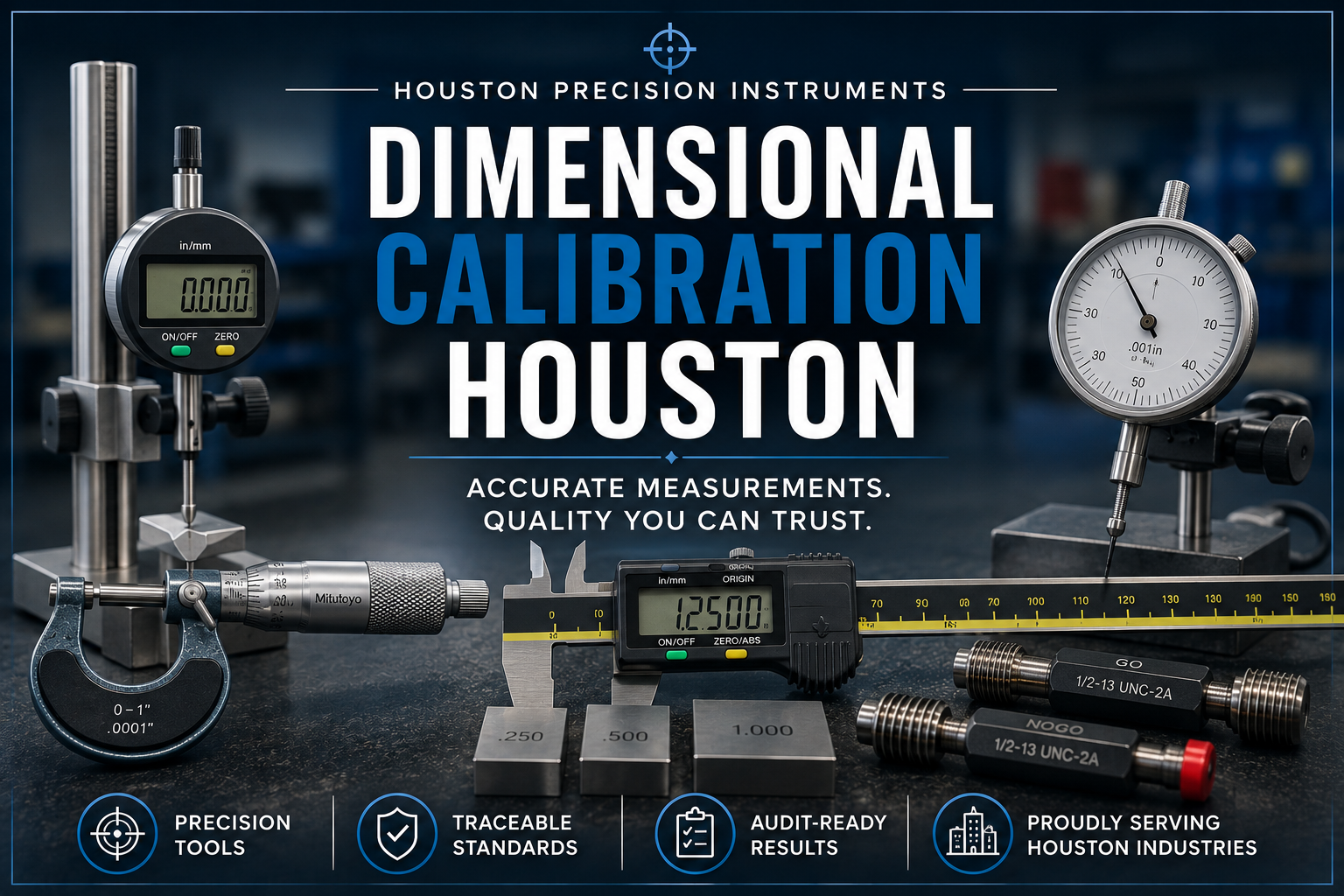
Dimensional Calibration Houston: Why Accurate Measurements Matter for Machined Parts, Gauges, and Quality Control
When your business depends on tight tolerances, accurate measurements are not optional. Dimensional calibration helps Houston manufacturers, machine shops, oilfield suppliers, and quality teams verify that their measuring tools are accurate, documented, and ready for use.
Request Calibration ServiceWhat Is Dimensional Calibration?
Dimensional calibration is the process of verifying measuring tools and instruments against known standards. These standards are traceable and used to confirm whether a tool is reading accurately within an acceptable tolerance.
If a measuring tool is out of tolerance, it can cause inaccurate inspections, rejected parts, customer complaints, or problems during an ISO, API, or customer quality audit.
Common Tools We Calibrate
- Calipers
- Micrometers
- Dial Indicators
- Bore Gauges
- Height Gauges
- Depth Gauges
- Thread Gauges
- Plug & Ring Gauges
- Pin Gauge Sets
- Gauge Blocks
Why Dimensional Calibration Matters in Houston Manufacturing
Houston has a large concentration of machine shops, oilfield manufacturers, fabrication companies, aerospace suppliers, industrial repair facilities, and precision machining operations. Many of these companies work with parts that must meet strict dimensional requirements.
In industries like oil and gas, energy, manufacturing, and industrial services, even small measurement errors can create costly problems. A caliper that is slightly off may lead to incorrect part acceptance. A thread gauge that has not been calibrated may allow nonconforming threads to pass inspection.
Dimensional Calibration Supports Quality Audits
For many Houston companies, calibration is not just about measurement accuracy. It is also about documentation. Quality programs often require calibration records that show the tool identification number, calibration date, due date, measurement results, traceability, and pass or fail status.
Having organized calibration documentation can make audits smoother and help your company show that inspection tools are being controlled properly.
Calibration Records May Include:
- Tool or gauge identification number
- Calibration date and due date
- Measurement results
- As-found and as-left condition when applicable
- Traceability to recognized standards
- Pass or fail status
- Technician or lab information
Common Tools That Need Dimensional Calibration
Calipers & Micrometers
These tools are used daily in many shops and are exposed to wear, drops, dirt, coolant, and general shop conditions. Regular calibration helps confirm they are still reading correctly.
Dial Indicators & Test Indicators
Indicators are commonly used for setup, alignment, runout checks, and inspection work. Because they rely on sensitive movement, they should be checked routinely.
Thread Gauges
Thread gauges are especially important for oilfield, API, and precision manufacturing work. Plug gauges and ring gauges help confirm whether threaded parts meet specification.
Bore Gauges & Depth Gauges
These tools are used for internal measurements and depth checks where accuracy is critical. Calibration helps confirm that these tools are giving reliable readings.
Gauge Blocks
Gauge blocks are often used as reference tools in inspection areas. Since other measurements may depend on them, they should be included in a regular calibration program.
Pin Gauge Sets
Pin gauges are commonly used for hole size verification, inspection checks, and quality control. Regular calibration helps maintain confidence in daily inspection work.
How Often Should Dimensional Tools Be Calibrated?
Calibration frequency depends on how the tool is used, the environment, the required tolerance, and your quality system requirements. Some tools may need annual calibration, while heavily used tools or critical gauges may need shorter intervals.
Lab Calibration vs. Onsite Dimensional Calibration
Lab Calibration
Lab calibration is often preferred when tools require a controlled environment, detailed inspection, or specialized standards.
Onsite Calibration
Onsite calibration can help reduce downtime, especially when a company has a large number of tools, gauges, or inspection instruments that need to be calibrated at the same time.
For many Houston businesses, the best approach is a combination of both lab and onsite calibration services.
Signs Your Dimensional Tools May Need Calibration
Dimensional Calibration for Houston Oilfield and Machine Shops
Oilfield manufacturing and precision machining often involve demanding tolerances and strict customer expectations. Threaded parts, machined components, assemblies, and inspection tools all depend on accurate dimensional measurement.
Houston Precision Instruments works with companies that need dependable calibration support for production, inspection, repair, and quality control operations.
Local Calibration Support
Whether you need a single micrometer calibrated or a full set of dimensional tools managed on a recurring schedule, having a reliable calibration partner can help keep your shop compliant and productive.
Benefits of Working With a Local Houston Calibration Lab
Keep Your Measurements Accurate and Your Records Audit-Ready
Dimensional calibration is one of the most important parts of a strong quality system. It helps ensure that measuring tools are accurate, inspection results are reliable, and calibration records are ready when customers or auditors ask for them.
For companies searching for dimensional calibration in Houston, Houston Precision Instruments provides calibration support for precision tools, gauges, and inspection equipment used across manufacturing, oilfield, machining, and industrial environments.
Request Dimensional Calibration