
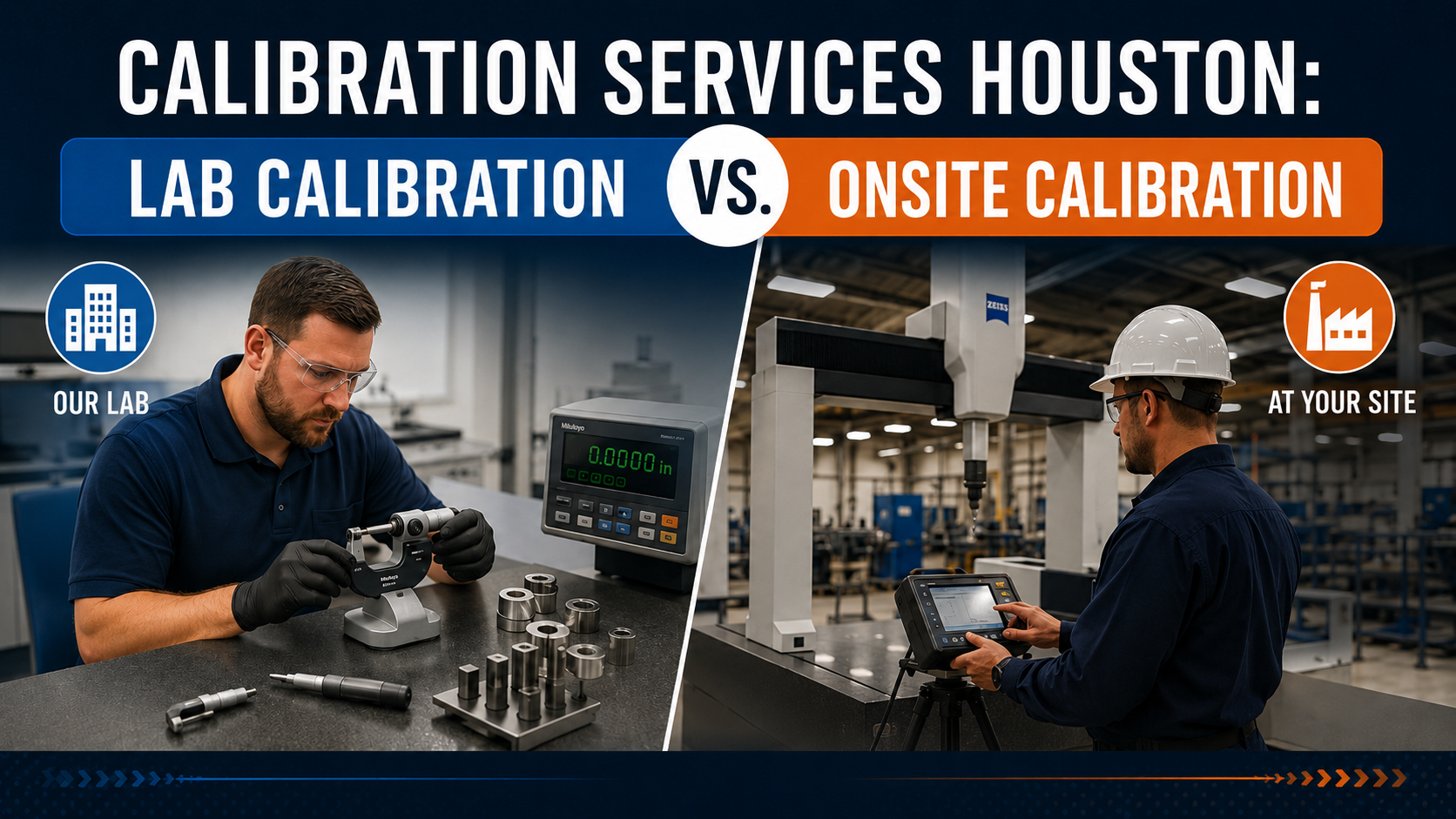
When your company depends on accurate measurements, calibration is more than a routine maintenance task. It protects product quality, supports compliance, reduces rework, and helps your team trust the instruments they use every day.
For manufacturers, machine shops, energy service companies, inspection departments, and quality teams in the Houston area, one of the most common questions is:
Should our instruments be sent to a calibration lab, or should calibration be performed onsite at our facility?
The answer depends on the type of equipment, the required accuracy, the size of the instrument, how often it is used, and how much downtime your operation can tolerate.
If you are comparing calibration services in Houston, this guide explains the difference between lab calibration and onsite calibration, when each option makes sense, and how Houston Precision helps local companies keep their measurement equipment accurate and dependable.
What Is Calibration?
Calibration is the process of comparing a measuring instrument against a known reference standard to determine whether the instrument is producing accurate results. If the instrument is outside its acceptable tolerance, it may need adjustment, repair, or replacement.
Common instruments that require calibration include:
- Calipers
- Micrometers
- Dial indicators
- Height gages
- Thread gages
- Plug and ring gages
- Torque wrenches
- Pressure gages
- Temperature instruments
- Electronic test equipment
- Optical comparators
- Surface roughness testers
- Coordinate measuring machines, also known as CMMs
Even high-quality instruments can drift over time due to normal use, wear, handling, environmental conditions, or accidental damage. Routine calibration helps catch these issues before they affect production or inspection results.
What Is Lab Calibration?
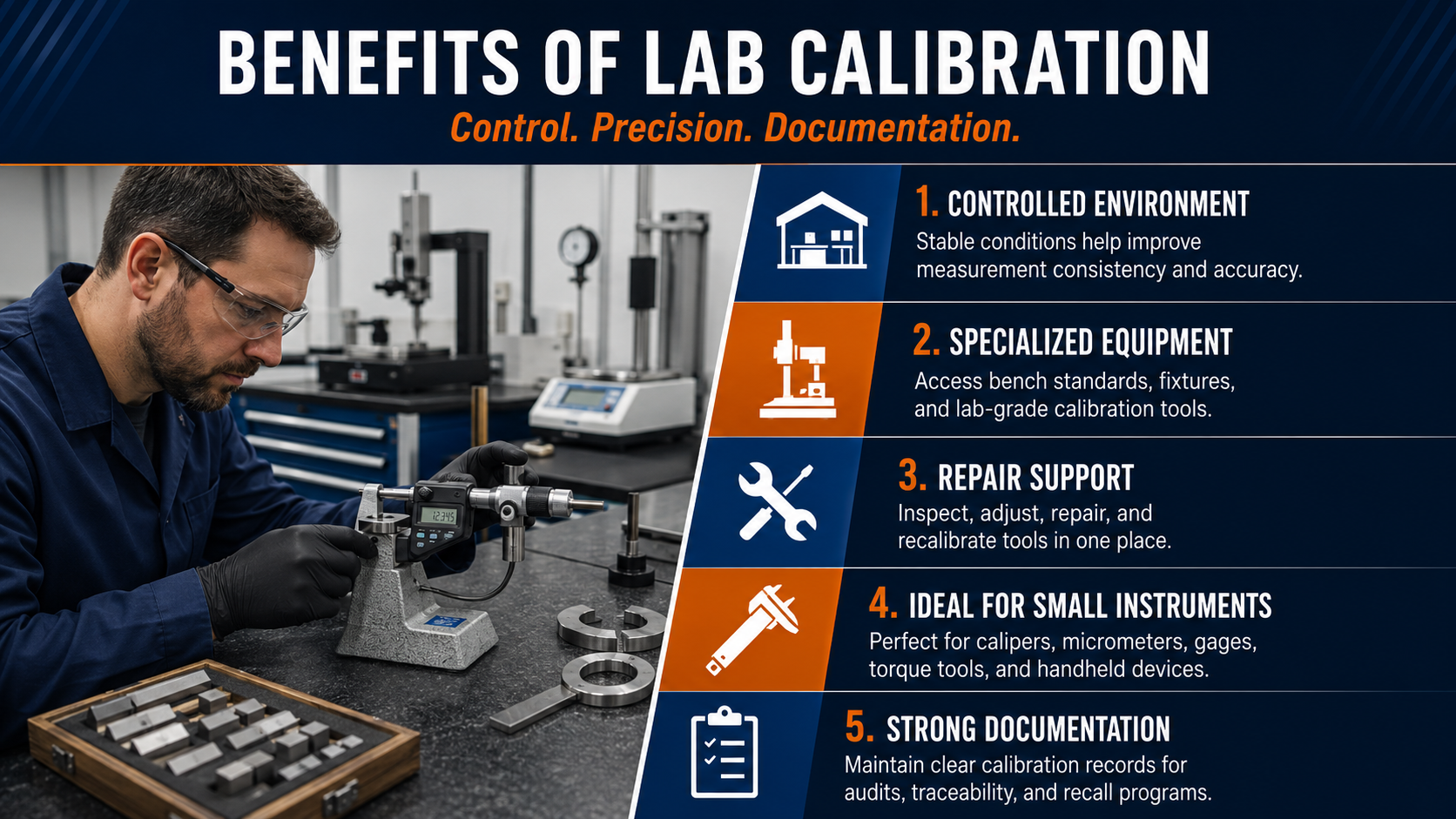
Lab calibration is performed in a controlled calibration laboratory. Instruments are brought into the lab, inspected, measured against appropriate standards, and documented.
Houston Precision provides lab gage and instrument services in a climate-controlled Polk Street laboratory, where factory-trained technicians repair and calibrate precision instruments to factory-specified tolerances.
Lab calibration is often the best choice for smaller, portable, or high-precision instruments that benefit from a stable environment and specialized bench-level equipment.
Common instruments suited for lab calibration include:
- Calipers
- Micrometers
- Indicators
- Thread gages
- Plug gages
- Ring gages
- Torque tools
- Handheld measuring tools
- Temperature instruments
- Pressure instruments
- Electronic instruments
For many companies, lab calibration is the standard option for recurring calibration programs because it provides a controlled environment and consistent documentation.
What Is Onsite Calibration?
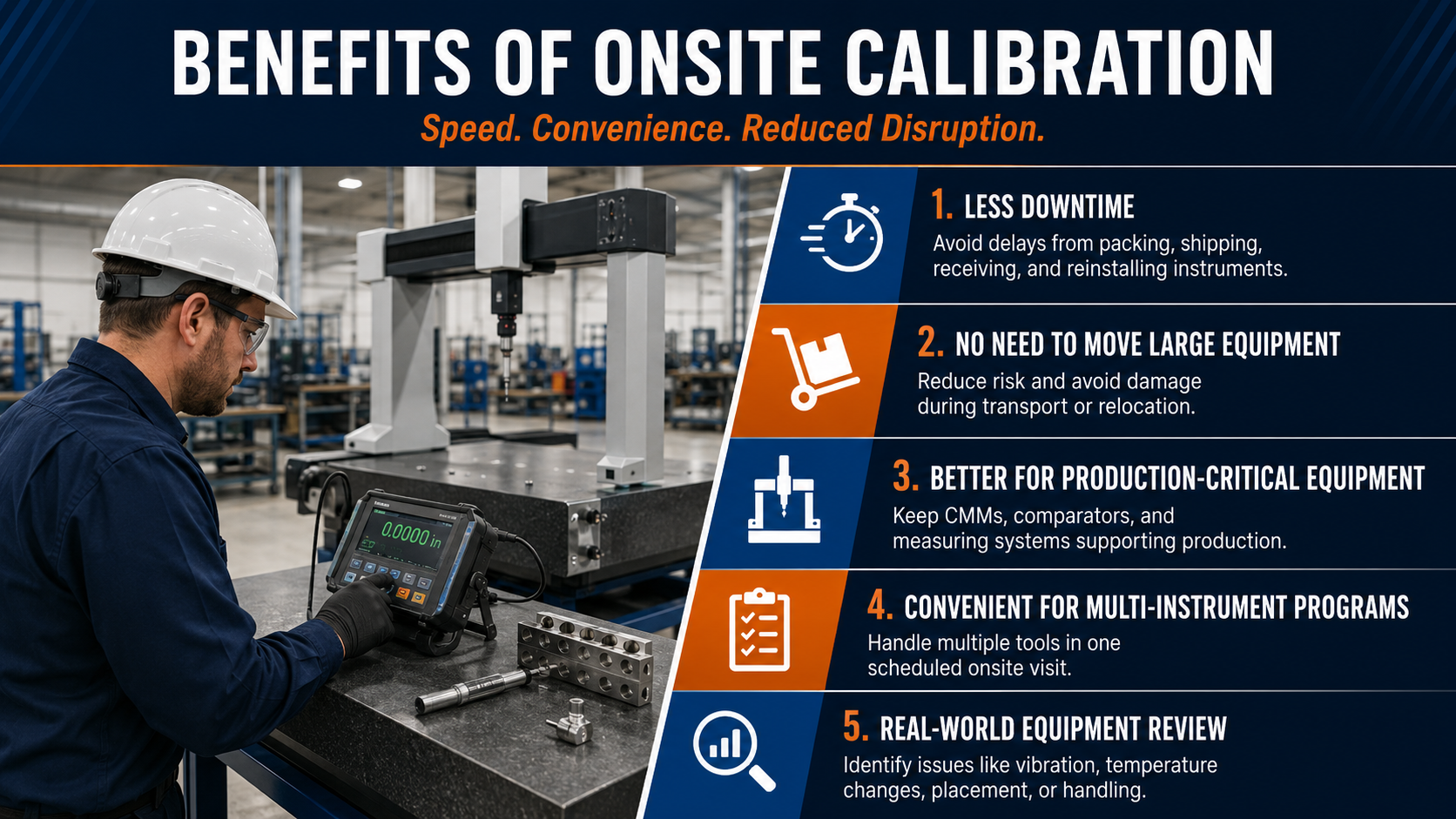
Onsite calibration is performed at your facility instead of in a calibration lab. A technician comes to your plant, shop, lab, or inspection area to calibrate eligible equipment where it is installed or used.
Houston Precision provides onsite calibration for selected equipment and instruments, including black body calibration service, super micrometer service, IR thermometer calibration, laser calibration service, roughness testers, optical comparators, and measuring systems.
Onsite calibration is especially useful when equipment is too large, sensitive, expensive, or disruptive to move.
Common equipment suited for onsite calibration includes:
- Optical comparators
- Large measuring systems
- Super micrometers
- Surface roughness testers
- IR thermometers
- Laser calibration systems
- CMMs
- Large or fixed inspection equipment
Onsite calibration can also be a good option when a company has a high volume of instruments and wants to reduce the downtime involved with shipping or transporting tools.
Lab Calibration vs. Onsite Calibration: Which One Do You Need?
The right option depends on the instrument and your operational needs.
| Situation | Best Fit |
|---|---|
| Small hand tools and gages | Lab calibration |
| High-precision instruments needing controlled conditions | Lab calibration |
| Instruments requiring repair or adjustment | Lab calibration |
| Large measuring systems | Onsite calibration |
| Equipment that is difficult to move | Onsite calibration |
| Production-critical inspection equipment | Onsite calibration |
| High-volume calibration events | Onsite calibration may be more efficient |
| Tools that need detailed bench inspection | Lab calibration |
| Optical comparators and large measuring systems | Often onsite |
| CMM calibration or repair | Usually onsite or specialized service |
In many cases, companies use both. Smaller tools are sent to the lab, while larger equipment is serviced onsite.
Where CMM Calibration Fits In
Coordinate measuring machines require specialized calibration and service. CMMs are often large, complex, and closely tied to inspection operations, so they typically require a more specialized service approach.
Houston Precision’s CMM Service Division includes CMM calibrations, diagnostics, repair, part programming, reverse engineering, software upgrades, retrofits, and other CMM services. The company also lists support for major CMM brands and software platforms, including Zeiss, Brown & Sharpe, Sheffield, Starrett, LK, Wenzel, Mitutoyo, Hexagon, FARO, ROMER, Calypso, PC-DMIS, MCOSMOS, and PolyWorks Inspector.
If your company relies on a CMM for part inspection, reverse engineering, or quality control, CMM calibration should be handled by technicians with specific CMM experience rather than treated like a standard hand-tool calibration.
When Should You Choose Lab Calibration?
Choose lab calibration when:
- The instrument is small enough to transport safely
- The tool requires a controlled calibration environment
- The instrument may need repair or adjustment
- You need detailed inspection of hand tools or gages
- Your calibration program is built around scheduled recall intervals
- You want consistent documentation for audits and quality records
Lab calibration is usually the best choice for calipers, micrometers, indicators, thread gages, plug gages, ring gages, torque tools, and many electronic, pressure, and temperature instruments.
When Should You Choose Onsite Calibration?
Choose onsite calibration when:
- The equipment is large, fixed, or difficult to move
- Shipping or transport could damage the equipment
- Downtime would disrupt production
- You have many instruments due for calibration at once
- The equipment is used directly in production or inspection
- The calibration needs to happen in the environment where the equipment operates
Onsite calibration is often the better choice for large measuring systems, optical comparators, roughness testers, IR thermometer systems, laser calibration needs, and CMM-related services.
What Happens If an Instrument Fails Calibration?
If an instrument fails calibration, it means the tool is not measuring within the required tolerance. At that point, the next step depends on the condition and value of the instrument.
Possible outcomes include:
- Adjustment and recalibration
- Repair and recalibration
- Limited-use designation
- Replacement
- Removal from service
This is also where having access to both calibration and replacement options can help. Houston Precision was established as a local calibration lab for the Houston energy services sector and is a sister company of Deterco, Inc., which Houston Precision describes as a stocking supplier of API gauges, thread element gauges, and metrology measuring instruments.
For customers who need to replace worn or damaged measuring tools, Deterco Online lists a wide range of quality-control and metrology products, including API gauges, calipers, calibration master instruments, CMM systems, bore gauges, granite surface plates, hardness testers, height gauges, handheld process calibrators, surface roughness testers, and more.
If a tool is no longer economical to repair, you can shop replacement precision measuring instruments through Deterco Online.
Why Houston Companies Need a Reliable Calibration Partner
Houston is home to energy, oil and gas, manufacturing, machining, fabrication, aerospace, and industrial service companies that rely on accurate measurement every day.
A dependable calibration partner helps your team:
- Maintain confidence in inspection results
- Reduce rejected parts and rework
- Support customer and audit requirements
- Keep tools organized through recall intervals
- Identify damaged or worn instruments early
- Minimize downtime for critical equipment
- Keep production and quality teams aligned
Houston Precision describes itself as a one-stop shop for quality instrument purchases and calibration needs, with more than 25 years of quality calibration services and service for Houston energy customers.
How to Prepare for Calibration Service
Before scheduling lab or onsite calibration, gather as much information as possible about the instruments that need service.
For lab calibration, prepare:
- Instrument type
- Manufacturer
- Model number
- Serial number
- Calibration due date
- Required tolerance or specification
- Any known damage or measurement issue
- Required documentation or recall interval
For onsite calibration, also prepare:
- Equipment location
- Available access around the equipment
- Power or environmental requirements
- Software version, if applicable
- Description of any issue or failure
- Preferred service window
- Internal safety or visitor requirements
Houston Precision’s onsite and CMM service quote forms request details such as manufacturer, model, serial number, dimensions, software version, and a description of the problem or issue.
Lab vs. Onsite Calibration: The Bottom Line
Lab calibration and onsite calibration both play an important role in a strong quality program.
Lab calibration is ideal for precision instruments, hand tools, gages, and items that benefit from a controlled laboratory environment.
Onsite calibration is ideal for large, fixed, sensitive, or production-critical equipment that is difficult to move or costly to take out of service.
For many Houston companies, the best answer is not one or the other. It is a combination of both.
By working with a calibration provider that offers lab services, onsite service, repair support, and CMM expertise, your team can build a calibration program that protects quality while minimizing downtime.
Need Calibration Services in Houston?
Houston Precision provides lab calibration, onsite calibration, CMM service, instrument repair, and metrology support for companies across Houston and the Gulf Coast.
Whether you need routine gage calibration, onsite service for large equipment, or specialized CMM support, Houston Precision can help you determine the right calibration approach for your instruments and your operation.
Contact us to schedule calibration service or discuss your instrument list.
FAQ
What is the difference between lab calibration and onsite calibration?
Lab calibration is performed in a controlled laboratory environment. Onsite calibration is performed at the customer’s facility. Lab calibration is often best for smaller precision instruments and gages, while onsite calibration is often better for large, fixed, or production-critical equipment.
Is lab calibration more accurate than onsite calibration?
Not always. The best method depends on the instrument, environment, standards, and required tolerance. Some instruments benefit from a controlled lab setting, while others are designed or required to be calibrated where they are installed.
What instruments can be calibrated in a lab?
Common lab-calibrated instruments include calipers, micrometers, indicators, torque tools, thread gages, plug gages, ring gages, pressure instruments, temperature instruments, and electronic measuring devices.
What equipment is usually calibrated onsite?
Large measuring systems, optical comparators, roughness testers, laser systems, IR thermometer systems, super micrometers, and CMMs are often good candidates for onsite calibration.
Does Houston Precision provide CMM calibration?
Yes. Houston Precision’s CMM Service Division provides CMM calibrations, diagnostics, repairs, part programming, reverse engineering, software upgrades, retrofits, relocation, and related CMM services.
What should I do if my tool fails calibration?
If a tool fails calibration, it may need adjustment, repair, recalibration, restricted use, or replacement. If replacement is the best option, Deterco Online carries many metrology and quality-control product categories, including calipers, API gauges, CMM systems, hardness testers, height gauges, granite surface plates, and calibration master instruments.