
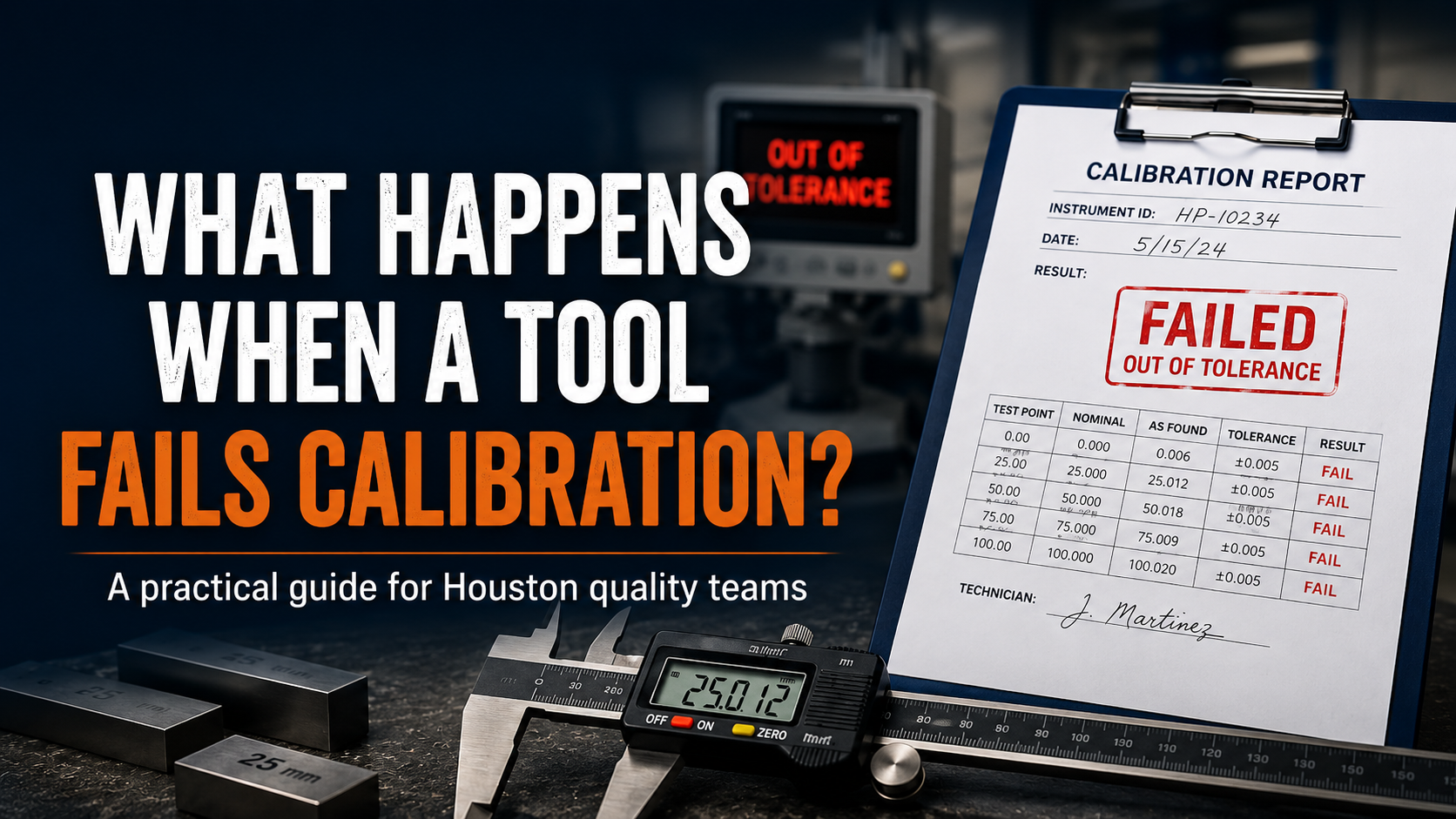
A failed calibration can create stress for any quality team. One day, a tool is being used for inspection or production checks. The next day, the calibration report shows that the instrument is out of tolerance.
That immediately raises important questions:
Was the tool giving bad readings?
Were any parts inspected with that tool affected?
Can the tool be adjusted or repaired?
Does it need to be replaced?
What documentation is required?
A failed calibration does not always mean disaster, but it does need to be handled correctly. For Houston manufacturers, machine shops, oilfield service companies, inspection teams, and quality departments, the right response protects product quality, audit readiness, and customer confidence.
This guide explains what a failed calibration means, what steps to take, and when repair or replacement may be the best option.
What Does It Mean When a Tool Fails Calibration?
A tool fails calibration when it does not meet the required tolerance or specification during calibration.
In simple terms, the instrument is no longer measuring accurately enough for its intended use.
For example:
- A caliper may not repeat measurements consistently.
- A micrometer may read slightly high or low.
- A torque wrench may apply more or less torque than expected.
- A pressure gage may drift outside acceptable limits.
- A thread gage may no longer verify parts correctly.
- A CMM or measuring system may produce results that do not match required standards.
When this happens, the tool is commonly described as out of tolerance or OOT.
A failed calibration means the tool should be reviewed before it is returned to service. Depending on the severity of the failure, the tool may need adjustment, repair, restricted use, replacement, or removal from service.
Common Reasons Tools Fail Calibration
Precision instruments can fail calibration for many reasons. Some failures are caused by gradual wear, while others happen suddenly because of damage or poor handling.
Common causes include:
- Normal wear from repeated use
- Drops or impact damage
- Dirt, chips, oil, or coolant contamination
- Worn measuring faces, jaws, threads, or anvils
- Loose components
- Electronics or display issues
- Temperature or environmental exposure
- Improper storage
- Overloading or misuse
- Corrosion or physical damage
- Previous repairs or adjustments
- Long calibration intervals
- Heavy use across multiple shifts
Even high-quality tools can drift over time. That is why routine calibration and proper tool handling are so important.
Houston Precision provides lab gage and instrument services in a climate-controlled Polk Street laboratory, where factory-trained technicians repair and calibrate precision instruments to factory-specified tolerances.
Step 1: Remove the Tool From Service
The first step after a failed calibration is simple: remove the tool from active use.
Until the issue is understood, the tool should not be used for production checks, inspection, final acceptance, or quality decisions.
Best practices include:
- Tagging the tool as out of service
- Separating it from usable tools
- Notifying the quality team
- Reviewing the calibration report
- Recording the failed status in your tool control system
- Preventing the tool from being returned to use by mistake
This helps reduce the risk of additional parts being measured with a questionable instrument.
Step 2: Review the Calibration Report
Next, review the calibration report carefully. The report should help determine what failed, how far the tool was out of tolerance, and whether the failure affects the tool’s intended use.
Look for:
- The measured value
- The accepted tolerance
- The amount of error
- Whether the tool failed at one point or multiple points
- Whether the issue affects the full range of the tool
- Whether the tool passed some functions but failed others
- Any technician comments
- Any recommended repair or adjustment
A small failure at one measurement point may require a different response than a major failure across the full range of the instrument.
Houston Precision also provides online access to calibration reports for active customers, allowing companies to access past and current calibration reports through the Houston Precision website.
Step 3: Determine Whether Product May Have Been Affected
This is one of the most important parts of the process.
If the tool was used before the failed calibration was discovered, your quality team may need to determine whether any parts, products, or inspection decisions were affected.
This is sometimes called an impact assessment.
Questions to ask include:
- When was the tool last known to be in tolerance?
- What parts were measured with this tool since the last valid calibration?
- Was the tool used for final inspection or only rough checks?
- Was it used on critical dimensions?
- Were other verified tools used to confirm the same measurements?
- How far out of tolerance was the instrument?
- Could the error have caused bad parts to be accepted?
- Could the error have caused good parts to be rejected?
The answer may be simple for a low-risk tool used occasionally. It may require a deeper review for a tool used in final inspection, tight-tolerance work, or customer-critical applications.
Step 4: Decide Whether the Tool Can Be Adjusted
Some tools that fail calibration can be adjusted back into tolerance.
Adjustment may be appropriate when:
- The tool is mechanically sound
- The error is correctable
- The adjustment is allowed by the manufacturer
- The tool can be verified after adjustment
- The cost of adjustment is reasonable
- The tool is worth keeping in service
After adjustment, the tool should be recalibrated and documented before it is returned to use.
For example, certain micrometers, torque tools, or indicators may be adjusted and verified. Other tools may not be practical to adjust, depending on their design, condition, or failure mode.
Step 5: Decide Whether Repair Makes Sense
If adjustment is not enough, the tool may need repair.
Repair may be the right option when:
- The tool is valuable enough to justify repair
- Replacement cost is high
- The issue is caused by a repairable component
- The tool is needed for a specific application
- Parts are available
- The tool can be recalibrated after repair
Common repair situations include:
- Damaged jaws or measuring faces
- Loose components
- Worn spindles
- Damaged indicators
- Torque tool issues
- Electronic display problems
- Broken or worn gage components
Houston Precision has provided repair and calibration services for more than 25 years and offers electronic, pressure, temperature, dimensional, torque, CMM calibration, and repair services both onsite and at its laboratory.
Step 6: Decide Whether Replacement Is the Better Option
Sometimes replacement is the best decision.
Replacement may make more sense when:
- Repair cost is close to replacement cost
- The tool is heavily worn
- The tool has failed repeatedly
- Parts are not available
- The tool is outdated
- Accuracy can no longer be trusted
- The tool is low-cost and high-use
- The tool is critical and reliability matters
For example, a worn caliper that repeatedly fails calibration may not be worth repairing. A damaged micrometer used for tight-tolerance inspection may be better replaced than returned to service with questionable long-term reliability.
This is where the relationship between calibration and product supply becomes useful. Houston Precision describes itself as a one-stop shop for quality instrument purchases and calibration needs, and notes that it is a sister company of Deterco, Inc., a stocking supplier of API gauges, thread element gauges, and metrology measuring instruments.
Deterco Online carries a wide range of metrology and quality-control product categories, including calipers, API gauges, calibration master instruments, bore gauges, granite surface plates, hardness testers, height gauges, handheld process calibrators, CMM systems, pressure gauges, thread element gauges, and more.
If a tool is no longer economical to repair, you can shop replacement precision measuring tools through Deterco Online.
Step 7: Update Your Calibration Records
Once the tool has been adjusted, repaired, replaced, restricted, or removed from service, your records should be updated.
Good documentation may include:
- Failed calibration report
- Tool ID or serial number
- Date of failure
- Failure details
- Adjustment or repair notes
- Recalibration results
- Product impact review
- Disposition decision
- Replacement record, if applicable
- Updated calibration interval
- Person responsible for the decision
This documentation helps support audits, customer reviews, internal quality meetings, and future calibration interval decisions.
What Does “As Found” and “As Left” Mean?
Calibration reports may include as found and as left conditions.
As found refers to the condition of the instrument before any adjustment or repair.
As left refers to the condition of the instrument after adjustment, repair, or final calibration.
For example, a tool may be found out of tolerance, adjusted by the technician, and then left in tolerance after recalibration.
Both conditions matter. The as-found condition helps your team determine whether previous measurements may have been affected. The as-left condition shows whether the tool is acceptable to return to service.
Should You Shorten the Calibration Interval After a Failure?
In many cases, yes.
If a tool fails calibration, your team should consider whether the calibration interval is too long for that tool’s use, environment, or risk level.
You may want to shorten the interval if:
- The tool is used heavily
- The tool failed by a large amount
- The tool is used for critical inspection
- The tool has failed before
- The tool is exposed to harsh conditions
- The tool is handled by multiple operators
- The tool is used across multiple shifts
For example, a caliper previously calibrated every 12 months may need a 6-month interval if it is used daily in a harsh shop-floor environment.
On the other hand, one isolated failure caused by a known event, such as a dropped tool, may not require changing the entire interval strategy.
Can a Failed Tool Still Be Used?
Sometimes, but only with clear restrictions.
A failed tool should not be used for its original purpose unless it has been adjusted, repaired, recalibrated, and approved.
In some cases, a tool may be downgraded for limited use. For example, it may be labeled for reference use only or used for non-critical checks where the failed range does not apply.
Any restricted use should be clearly documented and labeled so operators do not accidentally use the tool for critical inspection.
How to Prevent Future Calibration Failures
Not every failure can be prevented, but many can be reduced with better handling and tool control.
Best practices include:
- Store tools in protective cases
- Keep tools clean and dry
- Avoid dropping, stacking, or overtightening tools
- Train operators on proper use
- Check zero before use
- Use the right tool for the measurement
- Avoid exposing tools to unnecessary heat, coolant, or debris
- Perform routine in-house checks between calibration cycles
- Shorten intervals for high-use or high-risk tools
- Remove questionable tools from service immediately
- Review failed calibration trends over time
Houston Precision also provides in-house and onsite training classes for manufacturing and quality personnel, including topics such as basic dimensional measurement, gage maintenance, handling and storage, tool care, and gage selection.
When to Use Lab Calibration vs. Onsite Service
The best service option depends on the tool and the situation.
Lab calibration is usually best for:
- Calipers
- Micrometers
- Indicators
- Thread gages
- Plug gages
- Ring gages
- Torque tools
- Pressure instruments
- Temperature instruments
- Electronic instruments
- Tools that may need repair
Onsite calibration is often better for:
- Large measuring systems
- Optical comparators
- Super micrometers
- Roughness testers
- IR thermometer systems
- Laser calibration needs
- Equipment that is difficult to move
Houston Precision provides lab gage and instrument services in its climate-controlled laboratory and onsite calibration services at customer locations. Houston Precision’s onsite capabilities include black body calibration service, super micrometer service, IR thermometer calibration, laser calibration service, roughness testers, optical comparators, and measuring systems.
What Houston Quality Teams Should Do After a Failed Calibration
Here is a simple response checklist:
- Remove the tool from service.
- Review the failed calibration report.
- Determine the severity of the failure.
- Identify where and how the tool was used.
- Complete a product impact review if needed.
- Decide whether to adjust, repair, replace, restrict, or retire the tool.
- Recalibrate before returning the tool to service.
- Update calibration records.
- Review whether the calibration interval should change.
- Train operators if misuse or handling contributed to the failure.
A failed calibration should not be ignored, but it also should not cause panic. With a clear process, your team can make the right decision and protect your quality system.
Need Instrument Repair or Calibration Services in Houston?
Houston Precision provides lab calibration, onsite calibration, instrument repair, CMM service, and metrology support for companies across Houston, the Gulf Coast, greater Texas, Louisiana, Oklahoma, Arkansas, and Alabama.
If a tool has failed calibration, Houston Precision can help determine whether it can be adjusted, repaired, recalibrated, or should be replaced.
Request a quote today to review your failed calibration, schedule instrument repair, or update your calibration program.